





Can You Reupholster a Sofa With Your Own Fabric?
Table of Contents
- Can You Reupholster a Sofa With Your Own Fabric?
- What You'll Need Before You Start
- How to Assess Frame Integrity and Hidden Structural Repairs
- How Much Fabric to Reupholster a Sofa
- The Best Upholstery Fabric for High Traffic Sofas
- Step-by-Step: Removing, Templating and Rebuilding Your Sofa
- The Cost of Reupholstering a Sofa UK Homeowners Should Budget For
- Common Mistakes and Waste Management
- Frequently Asked Questions
Last Updated: October 4, 2026
Can You Reupholster a Sofa With Your Own Fabric?
Yes, you can reupholster a sofa with your own fabric. The job is well within reach for a careful DIYer, provided the frame is sound and you buy enough material. At Wish Interiors, we have spent over 60 years building handmade furniture, so we know where this project goes wrong.
Most sofas fail on two things: fabric quantity and frame condition. Get those right and the rest is patience.
Below, we show you exactly how to assess your frame, work out your yardage, and rebuild the sofa step by step. We also cover the real costs and the mistakes that ruin a good piece of furniture.
What You'll Need Before You Start
Gather your tools before you strip anything. A half-finished sofa with no staples is a sofa you cannot sit on.
You will need a staple gun, a staple remover or flat pry bar, fabric scissors, chalk, a tape measure, and heavy-duty thread. Add an upholstery needle, a tack strip, and a roll of dust cover fabric such as cambric.
For padding, budget for foam, batting, and dacron. Check your webbing and springs too. If the seat sags now, it will still sag under new fabric.
How to Assess Frame Integrity and Hidden Structural Repairs
Start with the frame before you spend a penny on fabric. A solid hardwood frame can be reupholstered many times. A cracked or wobbling one cannot.
Push down on each corner. Listen for creaks. Rock the sofa gently and watch for movement where the arms meet the seat.
Then look underneath. Lift the dust cover and check the joints. Loose joints can often be glued and clamped. Split rails usually mean the frame is finished.
Hidden repairs matter here. A sofa can look fine on top while the internal webbing has perished underneath. Replace worn webbing and re-pad the seat before you add new covers.
How Much Fabric to Reupholster a Sofa
Most three-seat sofas need 12 to 16 metres of fabric. A two-seater typically needs 10 to 12 metres, and an armchair around 6 to 8 metres. Those figures assume a standard upholstery roll width of about 140 cm and a plain fabric with no pattern repeat.
The exact figure depends on your sofa's size, the fabric's width, and whether it has a pattern. Plain fabric in a standard width is the easiest to plan for.
Work out your own number
Rather than guess from the ranges above, measure the panels you actually need. The method most upholsterers use is to treat each panel as a rectangle, add a seam allowance, then lay those rectangles out across the roll width.
Take a typical three-seater with these approximate panel sizes:
- Two inside arms: 70 cm × 90 cm each
- Two outside arms: 70 cm × 90 cm each
- Back panels: 180 cm × 90 cm
- Two seat cushions: 70 cm × 70 cm each
- Two back cushions: 70 cm × 50 cm each
- Front rail and deck: 200 cm × 40 cm
Add 5 cm to every edge for seam allowance and pull. Now lay the panels across a 140 cm roll. Two 70 cm panels sit side by side with no waste; a 180 cm back panel needs its own run. Once you have counted the runs, multiply by the length of the longest panel in each run. That total, rounded up to the nearest half metre, is your order.
Pattern repeat changes the maths
Patterned fabric needs extra material so the motif lines up across seams. The amount depends on the size of the repeat:
- Repeat under 15 cm: add 10 per cent
- Repeat 15-30 cm: add 15 per cent
- Repeat over 30 cm: add 20 per cent or more
A large repeat can also force you to buy an extra run, because you cannot always nest panels tightly without breaking the pattern. When in doubt, order one extra metre rather than risk a dye-lot mismatch later.
Roll width and railroading
Upholstery fabric usually comes in 140 cm or 280 cm widths. A 280 cm roll lets you 'railroad', run the fabric sideways across the sofa, which can cut waste on plain fabrics and reduce the number of seams. Railroading does not work with a directional pattern or a pile fabric such as velvet, because the nap will catch the light differently on each panel.
Quick planning checklist
- Measure the width, depth, and height of the sofa
- Note the width of your chosen fabric roll
- Sketch each panel and add 5 cm all round
- Add 10 to 20 per cent for pattern matching
- Round up to the nearest half metre
The Best Upholstery Fabric for High Traffic Sofas
Choose fabric by rub count and weight, not by looks alone. A high-traffic sofa needs a rub count of at least 25,000, and 30,000 or more for a busy family home.
Rub count is the number of abrasions a fabric withstands before it shows wear. Fabric weight, often given in GSM, tells you how dense and hardwearing the weave is. Heavier, denser fabrics generally last longer.
For high-traffic sofas, look at:
- Tight weaves such as linen blends and cotton mixes
- Performance fabrics with a high rub count
- Wool blends, which resist pilling and hold shape
Avoid loose weaves and delicate silks on a sofa that gets daily use. They look lovely and wear badly.
Outsunny Garden Rattan Sofa Cushion Polyester Cover Replacement Outdoor- No →
For outdoor or garden seating, a durable polyester cover works well. Our Outsunny replacement cushion covers are machine washable and zip on and off easily, which suits anyone refreshing cushions rather than rebuilding a frame.

Step-by-Step: Removing, Templating and Rebuilding Your Sofa
Work slowly and label everything. This is the stage where good preparation pays off.
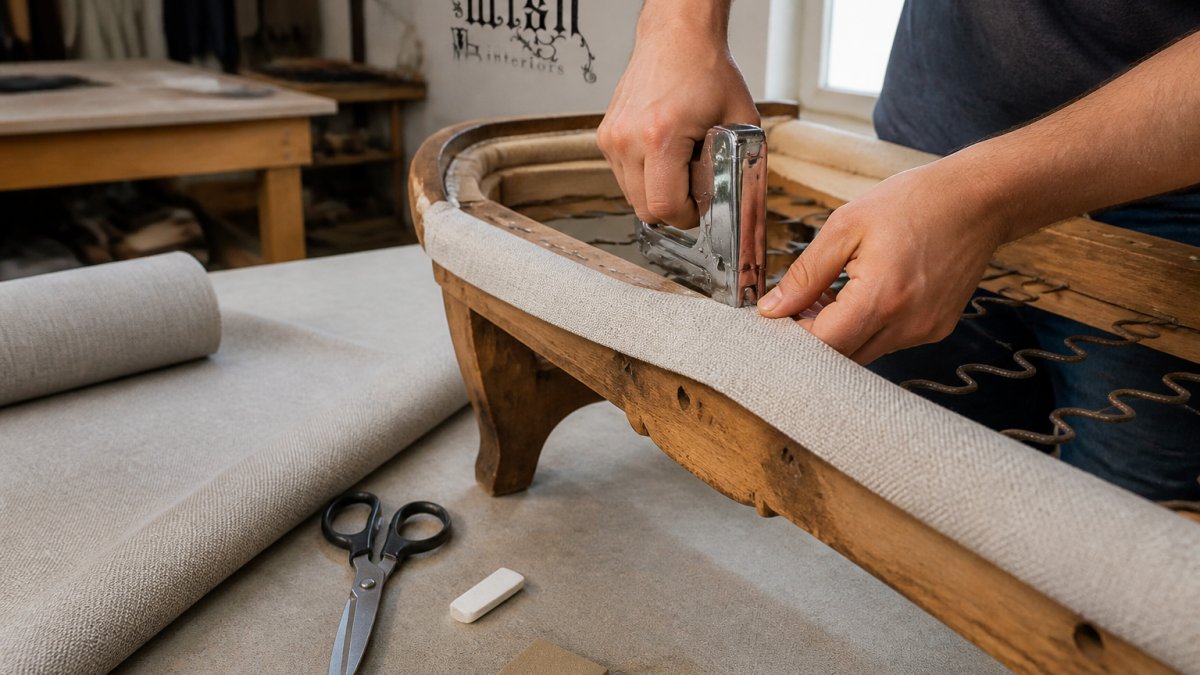
Step 1: Remove the old fabric. Pull staples with a remover or pry bar. Keep the old fabric intact where you can.
Step 2: Use the old fabric as a template. Lay each panel flat and trace it onto your new fabric with chalk. Mark the grain line and add a seam allowance.
Step 3: Cut with the grain. Align your panels so the weave runs the same way on every piece.
Step 4: Rebuild the base. Replace worn webbing, re-pad with foam and batting, and fit the sofa deck.
Step 5: Attach the new fabric. Staple from the centre outwards, pulling evenly to keep the tension right. Add cording, piping, and a fresh dust cover to finish.
The Cost of Reupholstering a Sofa UK Homeowners Should Budget For
Reupholstering costs far less than a new bespoke sofa, but it is not free. Fabric is your biggest single cost, and the price per metre varies widely by quality. Most upholstery-weight fabrics sit somewhere between £15 and £60 per metre, with performance weaves and wool blends at the upper end.
A professional service adds labour on top. Expect the total to climb with the sofa's size, the fabric you choose, and any structural repairs needed.
A rough cost-benefit comparison
Use the table below as a planning tool, not a quote. Fill in your own fabric price per metre and your own hourly value for time.
| Factor | DIY Route | Professional Service |
|---|---|---|
| Fabric (14 m at £25/m) | £350 | £350 (or sourced by the workshop) |
| Foam, batting, dacron | £80-£150 | Included |
| Webbing, staples, tack strip | £30-£60 | Included |
| Tools (staple gun, remover, scissors) | £60-£120 one-off | Included |
| Labour | 20-40 hours of your own time | Skilled hourly rate |
| Risk | Higher on first attempt | Lower, insured work |
| Best for | Simple frames, tight budgets | Complex frames, fine fabrics |
The time factor
A first-time DIY reupholstery job on a three-seater commonly takes 20 to 40 hours spread over several weekends. That is the hidden cost. If you value your time at £20 an hour, the DIY route carries an implicit £400-£800 of labour on top of materials.
A professional workshop will usually complete the same sofa in one to two weeks, depending on fabric lead time and any frame repairs. The trade-off is straightforward: you pay for speed, finish quality, and someone else's experience with piping, cording, and tight corners.
When DIY wins
DIY makes sense when the frame is sound, the fabric is plain, and the sofa has simple lines, a fixed-back two-seater, for example. The savings are real, and the skills you build carry over to cushions and dining chairs.
When professional wins
Professional upholstery is money well spent when the frame needs structural repair, the fabric has a large pattern repeat, or the sofa has curved arms, tufting, or a loose cover that must fit precisely. Fine fabrics such as velvet and silk are unforgiving of uneven tension, and a workshop will have the experience to handle them.
If the frame is sound but the task feels beyond you, Wish Interiors offers bespoke upholstery for both homes and commercial spaces, so you can hand the whole job over.
Common Mistakes and Waste Management
The most common mistakes all trace back to rushing. Cutting before templating, skimping on fabric, and stapling unevenly are the big three.
Other frequent errors:
- Skipping frame repairs and covering a weak structure
- Ignoring pattern repeat when ordering
- Pulling fabric too tight, which distorts the weave
- Leaving old staples in place, which snag new fabric
Waste matters too. Old fabric, foam, and staples add up fast. Recycle foam where your local centre accepts it, and keep usable offcuts for cushions or repairs.
Frequently Asked Questions
Can I reupholster my sofa myself, and if so, how?
Yes, you can reupholster a sofa yourself if the frame is structurally sound. Start by removing the dust cover and old fabric, keeping each piece as a template. Check the frame, webbing and springs for damage before rebuilding. You will need a staple gun, tack strip, batting and fabric. Allow 2-3 weekends for a first attempt. If the frame is cracked or the springs are broken, a professional service is the safer route.
What is the 2/3 rule for sofas?
The 2/3 rule suggests that if reupholstering costs more than two-thirds of the price of a comparable new sofa, buying new may be the better financial choice. For a well-built hardwood frame, reupholstering often makes sense because the structure outlasts the fabric. For a budget sofa with a softwood or particleboard frame, the cost of reupholstering a sofa UK buyers face can quickly exceed the value of the piece.
Do professional upholsterers accept customer-supplied fabric?
Many do, though some charge a handling fee or decline liability for fabric faults or shortages. Always order 10-15% extra fabric to cover pattern matching and cutting errors. Confirm the rub count and fabric weight meet the demands of your sofa before delivery. If you are supplying your own fabric, ask the upholsterer to confirm yardage requirements in writing so you are not caught short mid-project.
Is it cheaper to reupholster a sofa or buy a new one?
It depends on the frame quality. A solid hardwood frame with good springs is usually worth reupholstering, especially if the sofa has sentimental value or a shape you cannot replace. A mass-market sofa with a particleboard frame is rarely worth the labour cost. As a rough guide, reupholstering a two-seater typically costs between £400 and £1,200 in the UK, while a comparable new sofa may cost £600 to £2,000.
Reupholstering a sofa is a rewarding project, but it demands a sound frame, the right fabric, and careful work. If the frame needs hidden repairs or the fabric is delicate, the job is best left to skilled hands. Wish Interiors brings over 60 years of bespoke craftsmanship to every piece, with handmade furniture, custom upholstery, and unique artist collaborations for homes and commercial spaces. Get started with Wish Interiors and give your sofa a second life built to last.
Sample Image Gallery


