





Hand-Knotted Rugs vs Machine Made for Luxury Homes
Table of Contents
- The Core Difference: Hand-Knotted Rugs vs Machine-Made Rugs
- How to Identify Authentic Hand-Knotted Rugs
- Materials and Craftsmanship in Luxury Rug Making
- Rug Durability and Lifespan Comparison
- Luxury Rug Maintenance Tips
- Investment Value and Resale: Why Hand-Knotted Rugs Hold Worth
- Interior Design Integration and Indoor Air Quality
- Frequently Asked Questions
Last Updated: October 1, 2026
The Core Difference: Hand-Knotted Rugs vs Machine-Made Rugs
The core difference between hand-knotted rugs and machine-made rugs comes down to how the pile is formed. A hand-knotted rug is built knot by knot on a vertical loom, with each knot tied individually by an artisan, while a machine-made rug is produced on an automated loom that pushes yarn through a backing at speed. That single distinction drives everything else: material choice, durability, design flexibility, and long-term value.
For luxury homeowners, the gap matters. A hand-knotted rug is not simply a floor covering; it is a textile asset built to last decades. Machine-made rugs serve a purpose, but they are mass production items with a defined lifespan.
This guide from Wish Interiors examines both construction methods side by side. Below, we break down how to identify authentic hand-knotted rugs, compare durability, and explain why hand-knotted rugs hold their worth in a way machine-made rugs rarely do.
How to Identify Authentic Hand-Knotted Rugs
Identifying authentic hand-knotted rugs starts with the back of the rug. Turn it over. A genuine hand-knotted piece shows an irregular, slightly bumpy surface where individual knots were tied by hand. A machine-made rug has a uniform, flat backing, often with a glued or latex-coated finish.
Three checks separate the real thing from a convincing imitation:
- Knot density: Look for visible, countable knots. Higher knot density per square centimetre signals finer craftsmanship.
- Fringe: On a hand-knotted rug, the fringe is part of the warp threads, woven in, not sewn on. Machine-made fringes are stitched and often unravel.
- Irregularities: Slight variations in colour and pattern are a hallmark of hand-knotting. Perfect symmetry usually points to a loom.
What most guides miss is that price alone tells you little. A machine-woven rug can carry a premium retail tag without any of the structural markers above.
Materials and Craftsmanship in Luxury Rug Making
Material quality decides how a rug ages, and luxury rug making separates into two camps. Hand-knotted pieces typically use natural fibers: high-grade wool, silk blends, and sometimes cotton for the foundation. Machine-made rugs lean on synthetic materials such as polypropylene and polyester, which resist stains but flatten over time.
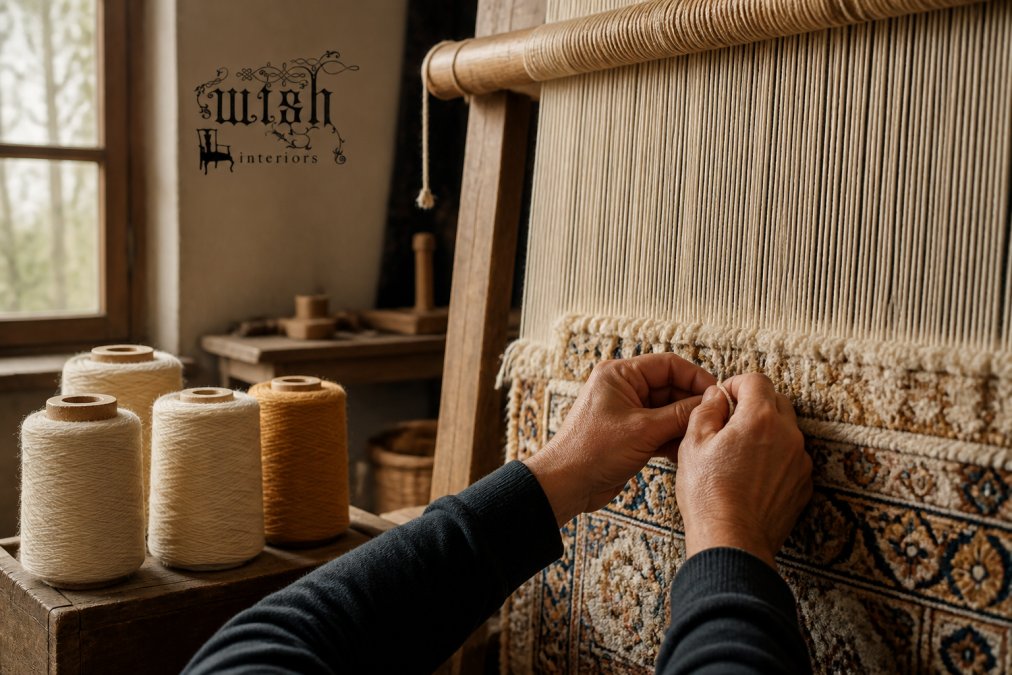
Wool grade matters most. Longer fibres, often called worsted wool, resist crushing and hold colour saturation for longer. Silk adds sheen and fine detail, which is why silk-blend rugs suit bespoke design work.
Rug Durability and Lifespan Comparison
Durability favours hand-knotted construction, and the gap is wide. A well-made hand-knotted rug, maintained properly, can last for decades and often becomes an heirloom. Machine-made rugs typically show wear within a few years in high-traffic areas.
| Factor | Hand-Knotted | Machine-Made |
|---|---|---|
| Construction | Individual knots on a loom | Automated loom, glued backing |
| Typical lifespan | Decades with care | A few years in busy rooms |
| Materials | Wool, silk, natural fibers | Synthetic materials |
| Repair | Re-knottable | Usually replaced |
| Resale value | Holds or grows | Minimal |
Luxury Rug Maintenance Tips
Luxury rug maintenance protects the textile integrity that makes a hand-knotted rug valuable. The routine is straightforward but consistent.
- Rotate every six months so traffic wear stays even.
- Vacuum gently with suction only, avoiding the fringe and beater bars.
- Blot spills immediately with a clean cloth; never rub.
- Use a rug pad to reduce friction and keep the pile upright.
- Book professional cleaning every two to three years, and always check the cleaner handles hand-knotted pieces.
Investment Value and Resale: Why Hand-Knotted Rugs Hold Worth
Hand-knotted rugs hold worth because supply is limited and provenance is verifiable. Each piece takes months to make, and no two are identical. That scarcity supports resale in a way mass production never can. Machine-made rugs depreciate the moment they leave the shop, while a hand-knotted piece can hold or grow in value where the design is tied to a recognised weaving tradition or a bespoke commission.
Documenting provenance from day one
The secondary market rewards a clear paper trail. Build the file at the point of purchase, not years later:
- The invoice and maker details, who wove it, the workshop or region, and the date of completion.
- Dimensions in centimetres, plus knot density per square centimetre, so a buyer can verify fineness without handling the piece.
- Materials and dye type, natural versus synthetic dyes materially affect value.
- Photographs of the front, the back, the fringe, and any selvedge, taken in even daylight.
- A record of every professional clean, with dates and the cleaner's notes.
What actually drives resale value
Not every hand-knotted rug appreciates. Value concentrates around a handful of factors:
| Factor | Supports value | Undermines value |
|---|---|---|
| Knot density | Fine, countable knots | Loose, sparse knotting |
| Dyes | Natural, evenly aged | Synthetic, prone to fading |
| Condition | Even pile, intact selvedge | Moth damage, water staining, repairs |
| Provenance | Documented maker and date | No paperwork |
| Design | Recognised tradition or bespoke commission | Generic or heavily altered pattern |
Routes to market
When the time comes to sell, luxury owners typically choose between three channels:
- Specialist rug dealers and auction houses, best for documented, high-knot-count pieces, but they take a commission and may hold stock for months.
- Private sale or trade-in, often the fastest route, and some workshops will take a piece back against a new commission.
- Estate and interior design networks, useful when the rug is part of a wider scheme being sold or reworked.
Interior Design Integration and Indoor Air Quality
Interior design integration is where hand-knotted rugs earn their place in a luxury scheme. Their irregularities and depth of colour read as bespoke, not uniform, which makes them easier to layer against natural stone, timber, and custom upholstery than a flat, machine-woven alternative. But the real skill is matching the rug to the architecture, not just the palette.
Matching the rug to the room
Different luxury spaces call for different constructions and formats:
- Open-plan living areas, a large hand-knotted rug defines a seating zone without walls. Choose a size that leaves at least 45-60 cm of bare floor around the furniture so the rug reads as an anchor, not a carpet.
- High-traffic hallways and stairs, a dense, low-pile hand-knotted runner in long-fibre wool resists crushing better than a thick, loose pile. Machine-made runners are cheaper but flatten quickly underfoot.
- Low-traffic formal rooms, silk-blend or finer-knotted pieces suit drawing rooms and studies, where footfall is light and the sheen can be appreciated.
- Bespoke and awkward spaces, an L-shaped living area, a bay window, or a low-ceilinged room can be fitted with a made-to-measure piece rather than forced into a standard size.
Layering is a useful technique in larger schemes: a hand-knotted rug as the base, with a smaller textured piece on top, adds depth without competing with the architecture. Keep the base rug neutral if the top layer carries the pattern.
Indoor air quality and the wellness angle
There is a health dimension that most comparison articles ignore. Natural fibres such as wool and silk release fewer volatile organic compounds than many synthetic materials, and wool naturally resists dust mites. For homeowners focused on indoor air quality, that is a genuine advantage over synthetic floor coverings, which can off-gas adhesives and finishes used in their backing.
A few practical points:
- Ventilate a new rug for a few days after delivery, particularly in a sealed, modern home.
- Vacuum with suction only and avoid beater bars, which can disturb fibres and release dust.
- Air the rug periodically in dry weather to keep it fresh.
Styling with confidence
At Wish Interiors, our family-run workshop has spent over 60 years crafting bespoke, handmade furniture and interiors, and we understand how a considered rug anchors a room. Pair a hand-knotted piece with our Luxury Natural Faux Fur Rug in layered schemes, or use the Carmel Cream-Blue Abstract Rug for a textured handcrafted look in a contemporary space.


Frequently Asked Questions
What is the most luxurious rug material?
Silk and high-grade wool are the most luxurious rug materials. Silk provides a fine, lustrous finish with high knot density, while wool offers natural resilience and warmth. Hand-knotted rugs made from these natural fibers are considered investment pieces because of their craftsmanship and longevity. Synthetic materials cannot replicate the depth of colour saturation or the tactile quality of natural silk and wool.
Are hand-knotted rugs considered a better long-term investment?
Hand-knotted rugs typically hold and grow in value over time due to their artisanal craftsmanship, provenance, and limited production. Unlike mass-produced machine-made rugs, each hand-knotted piece is unique. The secondary market for quality hand-knotted rugs remains active, with well-maintained pieces from recognised weaving traditions commanding strong prices at auction and through specialist dealers.
How can you distinguish between a hand-knotted and a machine-made rug?
Check the back of the rug: hand-knotted rugs show an irregular, slightly bumpy surface where individual knots were tied by hand, while machine-made rugs have a uniform, flat backing. Look at the fringe, which is part of the rug's foundation on hand-knotted pieces but sewn on separately for machine-made versions. Also examine the pattern: hand-knotted rugs show subtle irregularities that reflect human craftsmanship.
Do machine-made rugs offer better durability for modern luxury homes?
Machine-made rugs can be durable for high-traffic areas, but their lifespan is typically shorter than hand-knotted alternatives. A quality hand-knotted rug can last decades or longer with proper care, while machine-made rugs often show wear within 5 to 10 years. For luxury homes where longevity and textile integrity matter, hand-knotted rugs offer superior durability and the ability to be professionally restored.
Sample Image Gallery


