





Best High-Quality Bespoke Furniture for Custom Sofa Design
Table of Contents
- What Makes Bespoke Furniture Worth Choosing
- The Bespoke Sofa Design Process, Step by Step
- Choosing Upholstery Fabrics for Durability
- Custom Furniture Investment Value: What You Actually Pay For
- Standout Bespoke Sofa Designs from Wish Interiors
- Sustainability and Material Sourcing in Bespoke Manufacturing
- Maintaining Your Bespoke Sofa for Long-Term Longevity
- Frequently Asked Questions
Last Updated: September 13, 2026
What Makes Bespoke Furniture Worth Choosing
Bespoke furniture is seating built to your exact dimensions, fabric and configuration rather than adapted from a standard template. For anyone searching for the best high-quality bespoke furniture tailored to your vision for custom sofa design, the appeal is simple: the piece fits the room, not the other way round.
At Wish Interiors, we have spent over 60 years making made-to-measure upholstery for homes and commercial interiors. The difference between off-the-shelf and bespoke shows up in three places.
- Fit: awkward alcoves, low ceilings and L-shaped layouts stop being a compromise
- Longevity: hardwood and engineered-wood frames with high-density foam hold their shape far longer than budget equivalents
- Individuality: your fabric, your legs, your filling density, your proportions
That last point matters more than most buyers expect: a sofa is the largest upholstered purchase in most rooms, and the piece guests actually sit on.
The Bespoke Sofa Design Process, Step by Step
The bespoke sofa design process runs through six stages, and a well-run project keeps you involved at each one.
- Consultation. You share room dimensions, ceiling height, doorway clearance and how the space is used. Bring photos and any interior specifications you already have.
- Design and sketch. Frame style, silhouette, arm shape and leg finish are agreed before anything is cut.
- Fabric selection. You handle swatches at home, in your own light, not just in a showroom.
- Made-to-measure confirmation. Final dimensions are signed off, including seat height and depth.
- Handcrafted build. The frame is assembled and upholstered to the approved specification.
- Delivery and placement. The piece arrives assembled and positioned.
A common mistake is skipping step three. Fabric reads differently under a north-facing window than under showroom spotlights, the single biggest source of disappointment in custom upholstery.
Choosing Upholstery Fabrics for Durability
Choosing upholstery fabrics for durability comes down to matching fibre, weave and pile to the room it will live in. There is no single best fabric, only the right fabric for a given household.
Fabric Types and Where They Work Best
- Bouclé: textured looped yarn, excellent for statement pieces in low-traffic rooms. The Urban Contour Modular Sofa uses a dark grey bouclé to good effect.
- Velvet: dense pile with a deep colour response, best for formal seating and bedrooms.
- Suede and faux suede: soft hand-feel with strong colour depth, as seen on the Camaleonda Modular Sectional Sofa.
- Linen blends: breathable and relaxed, but creases, so better for occasional seating.
- Leather: the most forgiving surface for spills and pets, and it patinas rather than wears out.
Understanding Fabric Durability Ratings
Durability is usually expressed as a rub count, tested under a standard abrasion method; higher numbers suit heavier use. Ask your maker for the rub count, backing and finish of any fabric you are considering, because those affect performance as much as the fibre does.

| Fabric | Best For | Watch Out For |
|---|---|---|
| Bouclé | Statement sofas, low traffic | Snags on claws and jewellery |
| Velvet | Formal rooms, bedrooms | Shows shading and pressure marks |
| Suede / faux suede | Deep colour, soft touch | Needs regular brushing |
| Linen blend | Relaxed, airy interiors | Creases easily |
| Leather | Families, pets, hospitality | Requires conditioning |
Custom Furniture Investment Value: What You Actually Pay For
Custom furniture investment value sits in the frame, the filling and the labour, not the label. Two sofas can look identical and differ enormously underneath. The useful question is not "is bespoke worth it?" but "which parts of the build change how long the piece lasts, and which are cosmetic?"
Where the money goes, in order of impact
- Frame construction and joinery. A hardwood frame, beech, ash, kiln-dried birch, that is dowelled, screwed and corner-blocked resists racking and warping for decades. Softwood and particleboard frames flex, squeak and fail at the joints. This is the biggest determinant of lifespan and the hardest thing to inspect in a showroom, so ask what species is used and how corners are reinforced.
- Suspension. Eight-way hand-tied springs, serpentine systems and elastic webbing behave very differently. Hand-tied springs are the most labour-intensive and durable; webbing is cheapest and first to sag. Ask which system is used and whether it is covered by the frame warranty.
- Filling density. Seat foam is graded by density in kilograms per cubic metre. High-density foam (typically 30-35 kg/m³) keeps its loft for years; low-density foam (around 18-22 kg/m³) compresses into a hollow within a couple of years (bsigroup.com). Feather-and-down wraps feel luxurious but need daily plumping; a foam core with a down wrap is the common compromise.
- Fabric grade. A higher-grade cloth costs more per metre and generally lasts longer, but grade alone is not durability, weave, backing and finish matter as much as the fibre. Always ask for the rub count (Martindale) and backing specification.
- Tailoring and hand operations. Piped seams, channel tufting, buttoning and pattern matching are done by hand and visible in the finished piece. They add cost and are the clearest signal of a maker who is not cutting corners.
What bespoke does not buy you
Bespoke does not automatically mean better. A made-to-measure sofa built on a softwood frame with low-density foam and a cheap weave will underperform a well-specified modular range at the same price. The premium only pays off when the specification is genuinely higher, which is why the questions above matter more than the label.
When bespoke is not worth the premium
- A spare room used a handful of times a year.
- A rental you plan to leave within two years.
- A room where the layout may change and a modular range would adapt more cheaply.
Be honest about the use case before you commit: a bespoke piece is an investment in a specific room and way of living.
A simple way to compare two quotes
Ask each maker for the same five data points: frame species and joinery method, suspension type, seat foam density, fabric rub count and backing, and whether covers are removable. Two quotes that look £300 apart on paper can be a decade apart in service life once those answers are on the table.
Standout Bespoke Sofa Designs from Wish Interiors
The clearest way to judge bespoke quality is to look at finished pieces. These are ours, and each one solves a different problem.
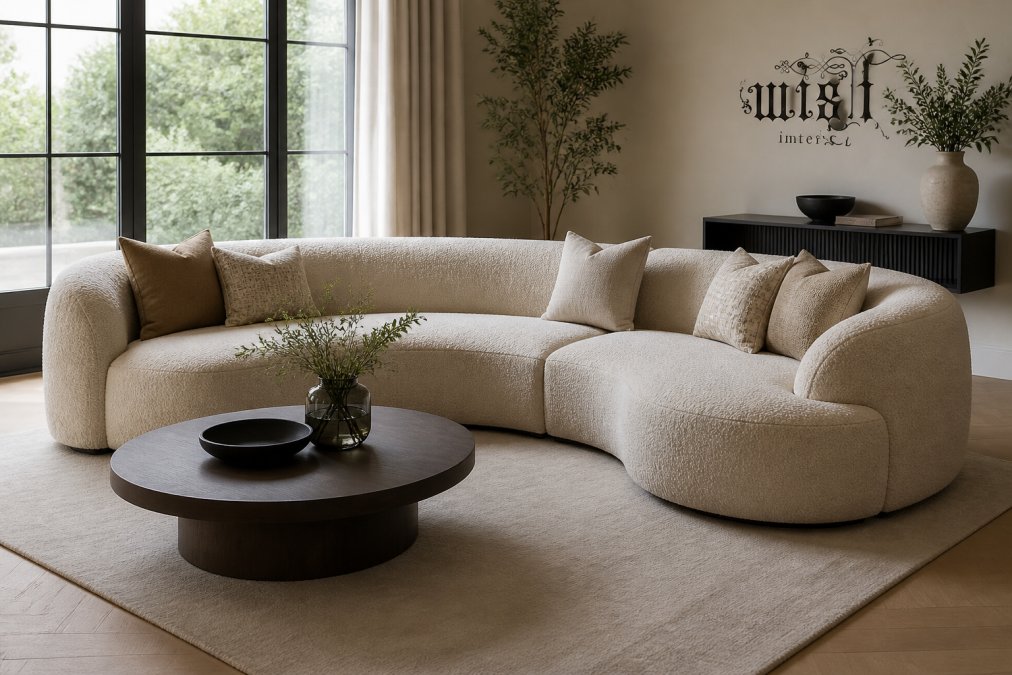
The Urban Contour Modular Sofa (£649.99) uses boneless construction with vertical channel tufting, so there are no rigid internal corners. Every surface is soft to the touch, making it sensible for households with young children.
For an L-shaped room, the Aura Modular Lounge Modular Sofa (£649.99) is our pick. Its three components reconfigure to fit the space, and removable, washable covers make it the most practical option for busy family rooms.

The Camaleonda Modular Sectional Sofa (£849.99) in faux suede suits anyone who wants a sculptural centrepiece. The Curva Channel Modular Sectional Sofa (£799.99) takes the same boneless approach with full channel tufting across an L-shaped footprint.
If you are building a sectional piece by piece, the Toulouse Grey Fabric Armless Modular Sofa (£593.99) slots between arm units to extend a run. Its frame is precision-built from 30% larch wood, 30% foam, 20% polyester, and 20% p.
For larger rooms, the Myers Five Seater Corner Sofa (£3,860.99) offers Nappa real leather on contact surfaces, and the Randal Corner Sofa (£1,979.99) is available in bouclé, velvet or suede across multiple sizes.
| Sofa | Price | Best For |
|---|---|---|
| Urban Contour Modular Sofa | £649.99 | Family rooms, soft-touch safety |
| Aura Modular Lounge Modular Sofa | £649.99 | L-shaped layouts, washable covers |
| Camaleonda Modular Sectional Sofa | £849.99 | Sculptural focal points |
| Curva Channel Modular Sectional Sofa | £799.99 | Open-plan entertaining |
| Toulouse Grey Fabric Armless Modular Sofa | £593.99 | Extending an existing sectional |
| Myers Five Seater Corner Sofa | £3,860.99 | Large rooms, leather |
| Randal Corner Sofa | £1,979.99 | Curved silhouettes, multiple fabrics |
Sustainability and Material Sourcing in Bespoke Manufacturing
Sustainability in bespoke manufacturing is mostly about two things: where the timber and textiles come from, and how long the finished piece stays out of landfill. A sofa that lasts twenty years has a far lower annual impact than one replaced every four, regardless of sourcing. That is the environmental argument for bespoke, and it is stronger than any single certification.
The materials that matter
- Timber. Look for frames made from responsibly sourced hardwood, beech, ash and kiln-dried birch are common, and ask whether the timber carries a recognised chain-of-custody certification. Reclaimed or reclaimed-blend timber is increasingly common for visible elements such as legs.
- Textiles. Natural fibres such as linen, wool and cotton are biodegradable and, where grown and processed responsibly, lower-impact than many synthetics. Recycled-content fabrics, often from post-consumer plastic, divert waste and are widely available in durable weaves. Ask what the fibre content is and whether dyeing and finishing are low-impact.
- Fillings. Natural fillings such as wool, horsehair and latex are renewable and breathable; some buyers prefer them for indoor air quality as well as environmental reasons. High-density polyurethane foam is the industry default and not biodegradable, though it is long-lasting and can often be replaced independently of the frame.
- Adhesives and finishes. Low-VOC adhesives and water-based finishes reduce indoor emissions. This matters most in bedrooms and small rooms where air changes are limited.
Three questions that expose a weak supply chain
- Is the frame hardwood, and where is it sourced?
- Are the covers removable, so the piece can be reupholstered rather than replaced?
- Can the filling be replaced independently of the frame?
A maker who can answer all three clearly is usually sourcing with intent. A maker who cannot is usually buying on price.
Why longevity is the real sustainability metric
The most sustainable sofa is the one you keep. Removable covers, replaceable fillings and a reupholsterable frame extend working life and reduce replacement frequency. When comparing two pieces, ask how each is designed to be repaired, not just how it looks.
Wish Interiors builds with hardwood and engineered-wood frames, which extends the working life of the piece considerably. If material sourcing is a priority for you, raise it at consultation stage so the specification can be built around it from the start.
Maintaining Your Bespoke Sofa for Long-Term Longevity
Furniture longevity is mostly maintenance, and most of it takes minutes rather than hours. Vacuum upholstery fortnightly with a soft brush attachment to lift surface dirt before it works into the weave.
Rotate and plump cushions weekly. Foam takes a compression set if it is loaded in the same place for months, and rotation is the cheapest way to prevent it.
For suede, leather and velvet, wipe periodically with a soft cloth, lukewarm water and a mild soap such as castile bar soap. Wipe again with a clean damp cloth, then buff dry with a soft cotton towel. Keep bespoke seating out of direct sunlight, because UV fades even high-grade cloth over several years (the NHS).
Bespoke furniture only rewards you if the specification is right, and getting it right takes a maker who will talk through frame construction, filling density and fabric performance rather than just showing you swatches. Wish Interiors has spent over 60 years building made-to-measure upholstery for homes and commercial interiors, with hardwood frames, removable covers on modular ranges, and artist collaborations for anyone who wants something genuinely individual. Call 020 46202525 to start your design consultation.
Frequently Asked Questions
What is the difference between custom and bespoke furniture?
Custom furniture is adapted from an existing design, so you choose the fabric and size but the frame and shape stay fixed. Bespoke furniture is built from scratch around your exact measurements, room layout and interior style. With bespoke, the frame construction, filling density and finish are all specified for your space, which is why bespoke pieces fit awkward rooms and low ceilings far better than off-the-shelf sofas.
How long does the bespoke sofa design process take?
The bespoke sofa design process involves several stages, from consultation to handcrafted build and delivery. If you are working to a renovation deadline, confirm lead times at the consultation stage so the sofa arrives when your room is ready.
How do I choose the right fabric for a bespoke sofa?
Start with how the room is used. Busy family spaces suit tightly woven fabrics and durable leather, while occasional-use living rooms can take softer textures like boucle or velvet. Check the rub count for abrasion resistance, and ask for a sample to view under your own lighting. For a tailored design, order a swatch and live with it for a few days before committing.
Is investing in high-quality bespoke furniture worth the cost?
Bespoke furniture costs more upfront than mass-produced pieces, but the custom furniture investment value comes from fit, materials and lifespan. A handcrafted sofa built to your dimensions with hardwood frame construction and high-density foam typically outlasts several cheaper replacements. It also fits your space exactly, so you avoid the compromises that come with standard sizing.
What should I look for when selecting a bespoke furniture maker?
Look for a maker with a clear design consultation process, transparent lead times and a portfolio of real completed work. Ask about frame construction, filling density and fabric sourcing. A workshop with decades of bespoke craftsmanship, such as Wish Interiors with over 60 years of experience, will explain exactly how your piece is built and offer a sample approval stage before production begins.
Sample Image Gallery


