





How to Style Curved Furniture in Small Living Rooms
Table of Contents
- Why Curved Furniture Works in Small Living Rooms
- Curved Sofa Small Living Room Layout: Planning Your Floor Plan
- How to Arrange Furniture in a Small Room Around Curves
- Bespoke Upholstery for Small Spaces: Custom Pieces That Fit
- Pairing Curved Pieces with the Right Accents
- Common Mistakes When Styling Curved Furniture in Small Rooms
- Conclusion
- Frequently Asked Questions
Last Updated: September 26, 2026
Why Curved Furniture Works in Small Living Rooms
Curved furniture is seating and tables with rounded, sweeping outlines instead of sharp corners, and it suits small living rooms better than most people expect. Rounded silhouettes soften edges and free up the floor space that square pieces waste. At Wish Interiors, we have spent over 60 years crafting handmade upholstery, and curves remain one of the most requested shapes for compact rooms.
Here is the counterintuitive part: a curved sofa often fits a tight room better than a straight one. Its rounded back follows the natural sweep of a walkway. Its edges have no corners to bump into.
The Royal Institute of British Architects guidance on domestic space notes that circulation space matters as much as floor area in smaller homes. Curves protect that circulation.
Below, we show you exactly how to plan, measure and style curved pieces so a small room feels open, not crowded.
Curved Sofa Small Living Room Layout: Planning Your Floor Plan
The best curved sofa small living room layout starts with a paper plan, not a shopping trip. Measure the room, mark the doors and windows, then place the curve so it faces the room's focal point.
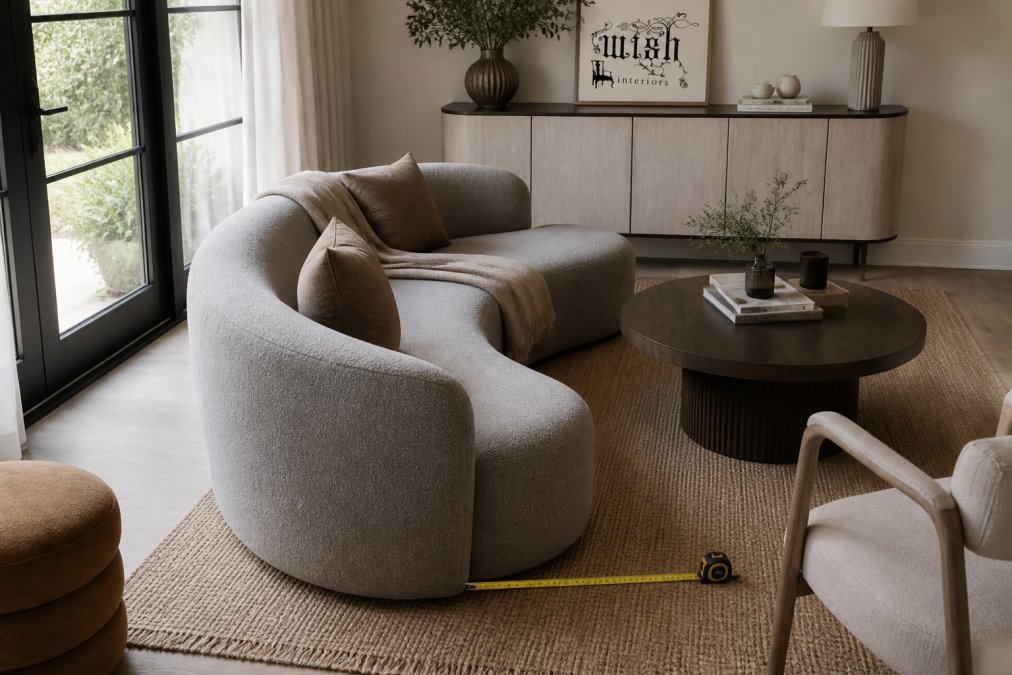
Measuring Traffic Flow and Clearance
Most styling guides stop at "leave some space." That is not enough when a curved piece eats into a walkway from every angle. Use these figures as your working minimums, then adjust for how you actually move through the room.
Measure these before you buy:
- The longest wall, corner to corner
- Every doorway, its width and its swing direction
- The gap between the sofa's widest point and the wall
- Your coffee table's diameter plus 40cm around it
- The distance from the sofa front to the TV or fireplace
A curved piece takes up more visual space than its footprint suggests. Plan for that.
Adapting the Plan for Studio Flats and Dual-Purpose Rooms
A curved sofa earns its keep in a studio or a living room that doubles as a home office, because the shape can define two zones without a wall. The trick is to let the curve do the dividing.
A common pattern is to float the curved sofa at roughly 45 degrees to the longest wall, with its back to the desk zone and its opening facing the seating zone.
A Worked Example for a Typical Small Room
Take a room 3.6m by 3.0m with one door in the corner and a window on the long wall. A curved sofa placed along the long wall, angled 10-15 degrees off it, can leave sufficient walkway to the opposite wall. A round coffee table centred on the sofa can leave adequate legroom. That can leave a corner for an accent chair or a slim desk, enough for a second function without blocking the door swing.

How to Arrange Furniture in a Small Room Around Curves
Arranging furniture in a small room around curves means letting the round shapes lead. Point the curve toward the room's centre, then fit straight pieces into the leftover gaps.
The Order That Works
Most people arrange a room by starting with the biggest piece and filling in around it. With curves, that is the wrong order. The curve is the piece that dictates sightlines, so it should be placed last, once you know where the walkways and the focal point sit.
A reliable sequence:
- Mark the focal point, the fireplace, the window, the TV. Everything else orients to it.
- Mark the primary walkway at 90cm. This is non-negotiable; it is the spine of the room.
- Place the straight, wall-hugging pieces first, console, shelving, desk. They use the awkward edges efficiently.
- Place the curved piece last, opening toward the focal point, angled 10-15 degrees off the wall.
- Fill the leftover gaps with small round or curved accents, not more large curves.
Balancing Curves with Linear Pieces
One curve per zone is enough. Too many rounded shapes and the room feels soft and shapeless.
Use linear contrast to anchor the curve:
- A rectangular rug under a curved sofa
- A straight console against the wall behind it
- A square side table beside a round chair
- A tall, narrow bookcase to give the eye a vertical line
Using the Dead Space Behind and Beside a Curve
A curved sofa creates two kinds of dead space that a rectangular one does not: the shallow crescent behind the back, and the two tapered gaps at either end where the curve pulls away from the wall.
Making One Curve Do Two Jobs
In a studio flat or a room that doubles as a home office, the curved piece should be the one item that serves both functions. A curved swivel chair is the simplest example: it can face the desk for work and swing to face the seating zone in the evening, so you are not buying two chairs for one floor space.

Bespoke Upholstery for Small Spaces: Custom Pieces That Fit
Bespoke upholstery for small spaces solves the problem ready-made furniture cannot: awkward dimensions. An L-shaped room, a low ceiling or a narrow bay window rarely suits a standard sofa. A made-to-measure piece fits the exact gap. Precision is essential when you measure space for sofas to ensure that every curve of your custom furniture integrates seamlessly into the room's unique architectural flow.
Choosing Fabrics and Finishes for Compact Rooms
Light, textured fabrics make small rooms feel bigger. Heavy dark upholstery can shrink a space.
For compact rooms, try:
- Boucle or velvet in pale grey, cream or seafoam
- A low-profile base to keep sightlines open
- A single accent colour, not three
Pairing Curved Pieces with the Right Accents
The right accents make a curved piece look intentional rather than accidental. An arched mirror is the easiest win: it echoes the curve and bounces light around a small room.
Pair curves with these:
- A round coffee table to repeat the shape
- An arched or circular mirror on the facing wall
- A curved bench or accent chair for extra seating
- A curved floor lamp to soften a corner
Common Mistakes When Styling Curved Furniture in Small Rooms
Most styling problems in small rooms come from treating curves like straight furniture. Here are the mistakes we see most often.
| Mistake | Fix | Why it matters |
|---|---|---|
| Pushing the curve into a corner | Angle it off the wall | Keeps the shape visible |
| Using three or more curved pieces | Limit to one per zone | Stops the room feeling shapeless |
| Skipping walkway measurements | Leave adequate clearance | Protects traffic flow |
| Choosing a heavy dark fabric | Use light textured upholstery | Keeps the room feeling open |
| Ignoring dead space behind the curve | Add a slim console or plant | Uses wasted floor area |
Conclusion
Styling curved furniture in a small living room comes down to planning, proportion and restraint. Measure your clearances, let one curve lead each zone, and anchor it with straight lines and light fabrics. That is how a compact room stays open and elegant.
Frequently Asked Questions
Is curved furniture still in style in 2026?
Yes, curved furniture remains a strong trend in 2026, particularly in small living rooms where its soft lines help with visual flow. The shift toward soft minimalism means rounded silhouettes and organic shapes are still favoured over hard edges. Curved sofas, accent chairs, and arched mirrors continue to appear in modern living room designs, and bespoke upholstery allows you to commission pieces that fit awkward layouts while staying on trend.
What should I pair with a curved sofa in a small room?
Pair a curved sofa with a round coffee table to echo its shape, and add a linear console or shelf against a flat wall to create contrast. A curved accent chair, like a swivel or velvet armchair, can complete the seating group without blocking traffic flow. Use an arched mirror to reflect light and add height. Keep the palette cohesive with two or three tones, and introduce texture through upholstery, throws, or a textured rug.
How do I arrange a curved sofa in a small living room without wasting space?
Start by measuring your floor plan and marking an adequate walkway around the sofa. Place the curve facing the room's focal point, such as a fireplace or TV, and pull it slightly away from the wall to create depth. Use the dead space behind the curve for a slim console or floor lamp. If the room is L-shaped, angle the sofa to follow the wall's turn. A modular curved sectional, like the Curva Channel Modular Sectional Sofa, can be reconfigured to suit your layout.
Can curved furniture make a small room look bigger?
Curved furniture can make a small room feel more open by softening edges and improving visual flow. Rounded silhouettes reduce visual clutter and allow light to move more freely around the space. However, scale matters: a piece that is too large will overwhelm the room. Choose furniture with a low profile and exposed legs to keep sightlines open. Pairing curves with a cohesive palette and strategic mirror placement enhances the effect.
A small room with awkward dimensions is exactly where bespoke furniture earns its place. Wish Interiors has over 60 years of family-run craftsmanship, builds every piece by hand to your measurements, and offers custom upholstery, printed sofas and limited-edition chairs for homes and commercial spaces. Spread the cost with Klarna and get seating made to fit your room, not the other way around. Call 020 46202525 to start your bespoke commission.
Sample Image Gallery


