





10 Ways to Style Bespoke Furniture in Modern Homes
Table of Contents
- Why Bespoke Furniture Belongs in a Modern Home
- 1. Let a Statement Piece Set the Room's Tone
- 2. How to Style a Bespoke Sofa as the Centre of the Scheme
- 3. Mixing Modern and Traditional Furniture Without Clutter
- 4. Bespoke Furniture Colour Schemes That Hold a Room Together
- 5. Choosing Upholstery for a Bespoke Sofa: Fabric, Texture and Durability
- 6. Layering Wood Finishes, Stone and Natural Materials
- 7. Scale, Proportion and the Tape Measure Rule
- What to Expect on Budget, Lead Times and Commissioning
- Frequently Asked Questions
Last Updated: October 17, 2026
Why Bespoke Furniture Belongs in a Modern Home
Bespoke furniture is made to measure for a specific room, so it fits awkward alcoves, low ceilings and L-shaped layouts that standard pieces never will. At Wish Interiors, we have spent over 60 years crafting handmade pieces, and we have learned that the best modern rooms are built around one or two made-to-measure anchors rather than a showroom set. The ten styling approaches below show how to use those anchors well.
A common mistake is treating a custom piece as the whole room. It isn't. A bespoke sofa or cabinet sets the tone; everything around it either supports that tone or fights it. The Royal Institute of British Architects' guidance on residential design makes the same point about proportion: a room works when its largest elements are planned first, not added last.
1. Let a Statement Piece Set the Room's Tone
Start with the single piece you want people to notice, then build everything else around it. That is the fastest route to a coherent room.
A custom sofa, a sculpted coffee table or a full-height cabinet can carry a whole scheme. Choose it first, decide its finish and fabric, and let the walls, rugs and lighting follow.
Our pick for a statement: the Aura Modular Lounge Modular Sofa at £655.99. Its rounded edges, pillow-like armrests and low profile make it an artful centrepiece rather than a bulky one. The modular format also means you can configure it to the room instead of forcing the room to fit it.

A second option, if you want something darker and more architectural, is the Camaleonda Modular Sectional Sofa at £857.99, upholstered in deep charcoal faux suede with button-tufted seating.

2. How to Style a Bespoke Sofa as the Centre of the Scheme
Styling a bespoke sofa means treating it as the room's fixed point: keep the surrounding palette quiet, layer texture rather than pattern, and let the sofa's shape do the talking.
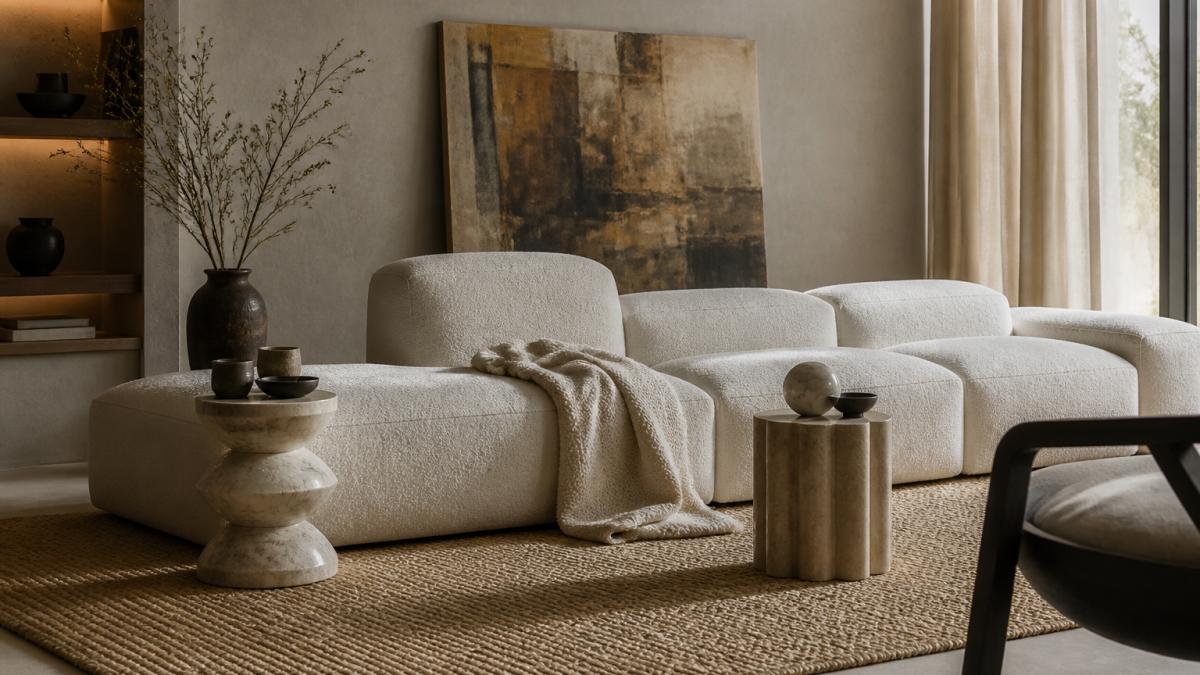
In practice, that means three moves. First, ground the sofa with a rug large enough that the front feet sit on it. Second, add one textural layer, a boucle or wool throw, and stop there.
The Curva Channel Modular Sectional Sofa at £807.99 shows the principle well. Its vertical channel tufting and rounded, armless design already provide visual interest, so it needs almost nothing around it.

3. Mixing Modern and Traditional Furniture Without Clutter
Mixing modern and traditional furniture works when one style clearly leads and the other supports. Give the lead style roughly two-thirds of the visual weight and keep the supporting pieces few.
The clutter problem usually comes from balance, not quantity. A handmade piece with traditional details, such as turned legs or a lacquered finish, sits comfortably beside clean lines if the colours echo each other.
A practical formula we use: one traditional piece, one contemporary piece, one neutral bridge. The bridge is often a rug, a plain upholstered chair or a simple lamp that borrows a colour from both sides.
The Franklin Dark Mango Wood Console Table with 2 Drawers at £215.99 is a good traditional anchor.
4. Bespoke Furniture Colour Schemes That Hold a Room Together
A bespoke furniture colour scheme holds together when you limit it to three tones and repeat each one at least twice across the room.
Choose a dominant tone for the largest surface, usually the sofa or cabinetry, a secondary tone for walls and flooring, and one accent. Then repeat the accent in two smaller places: a cushion, a vase, a frame. Repetition is what makes a palette look deliberate rather than accidental.
For made-to-measure pieces, decide the colour before the commission is confirmed. Changing a fabric after production starts is expensive and slow. Warm neutrals and deep charcoals are the safest long-term choices because they accept almost any accent you introduce later.
The Merlin Mango Wooden Round Coffee Table Mushroom Style at £223.99 brings a natural wood tone into the scheme without adding a fourth colour, which is exactly what a tight palette needs.
5. Choosing Upholstery for a Bespoke Sofa: Fabric, Texture and Durability
Choose upholstery by room use first, then texture, then colour. A sofa in a busy family room needs a tightly woven, hard-wearing fabric; a formal sitting room can carry a softer, more tactile weave.
Three things decide how a fabric performs: the weave tightness, the fibre, and the amount of texture. Tight weaves resist pilling and snagging. Textured fabrics such as boucle and chenille hide marks better than flat weaves. And removable, washable covers make the biggest practical difference in a household with children or pets.
Aura Modular Lounge Modular Sofa →
Our Aura Modular Lounge Modular Sofa uses removable, washable covers, which is the detail most buyers forget to ask about until the first spill.
6. Layering Wood Finishes, Stone and Natural Materials
Layering materials works when each one has a different job: wood for warmth, stone for weight, textile for softness. Two of any one material is usually enough in a single room.
Wood interiors and wood finishes carry the warmth in a modern scheme, but too many competing wood tones make a room look unsettled. Stick to two: one darker, one lighter. Stone, whether travertine or marble, adds cool weight and pairs naturally with both.
The Forster Triangle Coffee Table, Travertine at £617.99 shows how a natural stone surface anchors a seating area. Its triangular shape also suits smaller spaces, where a rectangular table would crowd the walkway.
For contrast at a lower price, the Sculptural Trestle Side Table at £150.99 uses a distressed engineered wood finish with an hourglass silhouette, adding texture without another strong colour.
7. Scale, Proportion and the Tape Measure Rule
The tape measure rule is simple: measure the room, measure the route the piece must travel, and measure the piece against the wall it will sit against. If any of those three numbers is wrong, the commission is wrong.
Proportion failures are the most common and the most expensive. A sofa that fits the wall but blocks a doorway, or a cabinet that cannot turn the stair corner, cannot be fixed after delivery. Before commissioning, record four measurements:
- Wall length where the piece will sit, plus the height of any skirting or radiator
- Doorway width and height on the delivery route
- Stair turn dimensions if the piece goes upstairs
- Clear walking space you want to keep, usually at least 90cm in a main route
For awkward L-shaped rooms and low ceilings, a modular design solves most of the problem. The Camaleonda Modular Sectional Sofa is built from individual modules, so it can be arranged around a corner rather than forced against one wall.
What to Expect on Budget, Lead Times and Commissioning
Most buyers underestimate the commissioning timeline because they treat furniture like a retail purchase. A made-to-measure piece is produced after you approve the specification, so the clock starts at sign-off, not at enquiry. A realistic pattern is four to six weeks for a simple upholstered piece, six to ten weeks for cabinetry with a sprayed finish, and longer for natural stone tops or hand-finished veneers.
On cost, the price is driven by four things: overall size, fabric or finish grade, frame construction, and detailing such as piping, stitching or inlay. A larger piece in a harder-wearing fabric will always cost more, and that holds across the industry.
A practical commissioning sequence that avoids most disputes:
- Agree the specification in writing, including dimensions, fabric code, finish and hardware.
- Approve a physical sample or a large-scale swatch under room lighting, not a small swatch alone.
- Confirm the delivery route and access constraints before production begins.
- Pay a deposit only against a written order that states the lead time and the cancellation terms.
- Inspect on delivery and record any issues in writing within the maker's stated window.
Under the Consumer Rights Act 2015, goods must be as described, of satisfactory quality and fit for purpose, and bespoke items are not exempt from that standard.
Finally, ask what happens if the finished piece is not what you approved. A good maker will explain how they check the specification with you before production and how they handle adjustments afterwards. Get that answer before you pay a deposit, and keep the written specification alongside your order confirmation.
Frequently Asked Questions
How do you style bespoke furniture in a modern home?
Start with one anchor piece, usually a bespoke sofa or cabinet, and build the room around it. Keep the surrounding furniture simple so the custom piece reads as the focal point. Repeat one or two materials, such as oak and linen, across the scheme to create harmony, and leave breathing space around anything handmade so its detail is visible. A tape measure helps you confirm walkways of at least 90cm before you commit.
What colours work well with bespoke furniture?
Neutral bases of warm white, stone or soft grey let bespoke furniture colour schemes stay calm while the craftsmanship does the talking. Add depth with one darker tone, such as charcoal, olive or deep navy, on upholstery or cabinetry. If the piece is a bold colour, keep walls quiet and repeat the shade once elsewhere in the room, through a cushion or a rug, so the colour feels deliberate rather than accidental.
Can bespoke furniture work in a minimalist interior?
Yes, and it often works better than mass-made pieces. Minimalist decor relies on clean lines and few objects, so every item has to earn its place. A handmade piece with a considered silhouette, such as a channel-tufted sofa or a travertine coffee table, gives a pared-back room warmth and character without adding clutter. Keep surfaces clear and let one or two textures, like boucle and wood, carry the visual interest.
How do you mix modern and traditional furniture without it looking messy?
Use a 70/30 split rather than an even mix. Let the dominant style set the room, then introduce two or three pieces from the other era as accents. Tie the two together with a shared colour palette or a repeated material, such as brass handles or dark wood, so the contrast reads as intentional. Keep traditional details to one or two statement items and let contemporary pieces handle the bulk of the seating and storage.
How long does bespoke furniture take to make, and what should I budget?
Lead times vary with complexity, and made-to-measure pieces typically take longer than stock items because they are built to your measurements. Ask for a written timeline before you order and factor it into your renovation schedule. On budget, set aside a contingency of around 10 to 15 per cent for fabric upgrades, delivery and any fitting work. Payment plans such as Klarna can spread the cost of larger commissions.
A modern room only feels finished when its largest pieces were planned rather than bought in a hurry. If you are commissioning made-to-measure furniture for a renovation, Wish Interiors can help: over 60 years of craftsmanship, handmade pieces built to your measurements, and custom upholstery for homes and commercial spaces, all from one team. Call 020 46202525 to talk through your project and get started.
Sample Image Gallery


