





Corner Bench Dining Table: The 2026 Buying Guide
Table of Contents
- Why a Corner Bench Dining Table Saves Space
- Measuring Your Space for a Corner Bench Dining Table
- Bespoke Corner Banquette Seating: DIY vs Custom Built-In
- Upholstered Dining Bench Design: Fabrics and Comfort
- Small Kitchen Dining Solutions: Space-Saving Table Shapes
- What Corner Bench Dining Tables Cost in 2026
- Styling and Caring for Your Corner Dining Nook
- Frequently Asked Questions
Last Updated: September 29, 2026
Why a Corner Bench Dining Table Saves Space
A corner bench dining table pairs a table with bench seating built into a corner, so the seating wraps around two walls and the floor beneath doubles as storage. In compact kitchens and open-plan living rooms, it reclaims wasted dead zone and seats more people per square metre than a freestanding table with chairs.

Measuring Your Space for a Corner Bench Dining Table
Measure the two walls the bench will sit against, then subtract the bench depth from your usable floor space. Most benches run 45cm to 55cm deep, so a 1.8m wall leaves roughly 1.25m of clear floor.
Table Dimensions and Seating Capacity
Table dimensions decide seating capacity. Allow 60cm of table edge per person, and 75cm for elbow room.
| Table Size | Seats Comfortably | Best For |
|---|---|---|
| 110 x 70cm | 2-3 people | One-bedroom flats, breakfast corners |
| 120 x 75cm | 4 people | Small kitchen diners |
| 140 x 80cm | 4-6 people | Open-plan living, family homes |
| 160 x 90cm | 6 people | Larger kitchen extensions |
Left-Hand Facing vs Right-Hand Facing Benches
Left-hand facing and right-hand facing describe which wall the bench's long run sits against when you stand at the table. Order the wrong one and the bench will not fit the corner, however good the measurements looked.
Bespoke Corner Banquette Seating: DIY vs Custom Built-In
Bespoke corner banquette seating costs more than a flat-pack bench, and the gap is wider than most expect. Whether you are paying for fit or just for a label depends on how square your corner is, how much time you have, and whether the bench needs to be demountable.
DIY: what it actually involves
A DIY corner bench is usually a plywood or MDF box carcass, clad and painted or upholstered, with a hinged or lift-off lid for storage. The build sequence:
- Batten the walls. Fix 50 x 50mm timber battens to the two walls at seat height (typically 45cm) to carry the frame. This avoids fixing into skirting and lets you shim out any out-of-square gap.
- Build the base box. 18mm plywood is the sensible minimum for a seat that will take adult weight repeatedly; 15mm flexes over time. Cut the front panel and two end panels, then join with pocket screws or dowels and glue.
- Add internal dividers. One divider every 60cm stops the lid sagging and gives the storage bays structure.
- Fit the seat top. 18mm ply or MDF, hinged at the front edge so it lifts toward the wall. Use a piano hinge rather than two butt hinges for a cleaner line and less racking.
- Upholster or paint. A foam cushion cut to size and wrapped in fabric, stapled to a separate board that sits on top, is easier to remove for cleaning than a stapled-to-carcass finish.
Custom built-in: what you are actually buying
A bespoke banquette is measured on site, built to those measurements, and usually installed by the maker. The value is not the timber; it is the scribing. A good maker templates the corner, allows for skirting, radiators and pipework boxing, and delivers a bench that meets both walls with no visible gap.
The middle path most renovations take
Buy the table and bench as a matched set, then have the seat cushions re-upholstered in your fabric. You get the tailored look without the built-in price and can change the fabric later without rebuilding the frame. It suits a kitchen diner where the bench sits against two true walls and the skirting is low.

How to choose
- Choose DIY if the corner is square, the walls are true, you want storage, and you are comfortable with a saw and a staple gun.
- Choose bespoke if the corner is out of square, the walls are listed or uneven, the bench must fit around a radiator or boxing, or you want a seamless upholstered finish with no visible fixings.
- Choose the middle path if the frame is straightforward but you want a specific fabric and a professional cushion finish.
Upholstered Dining Bench Design: Fabrics and Comfort
Upholstered dining bench design comes down to two decisions: the fabric and how the seat is built underneath it. Get the fabric wrong and a beautiful bench looks tired within a year; get the cushion wrong and nobody wants to sit through a long dinner.
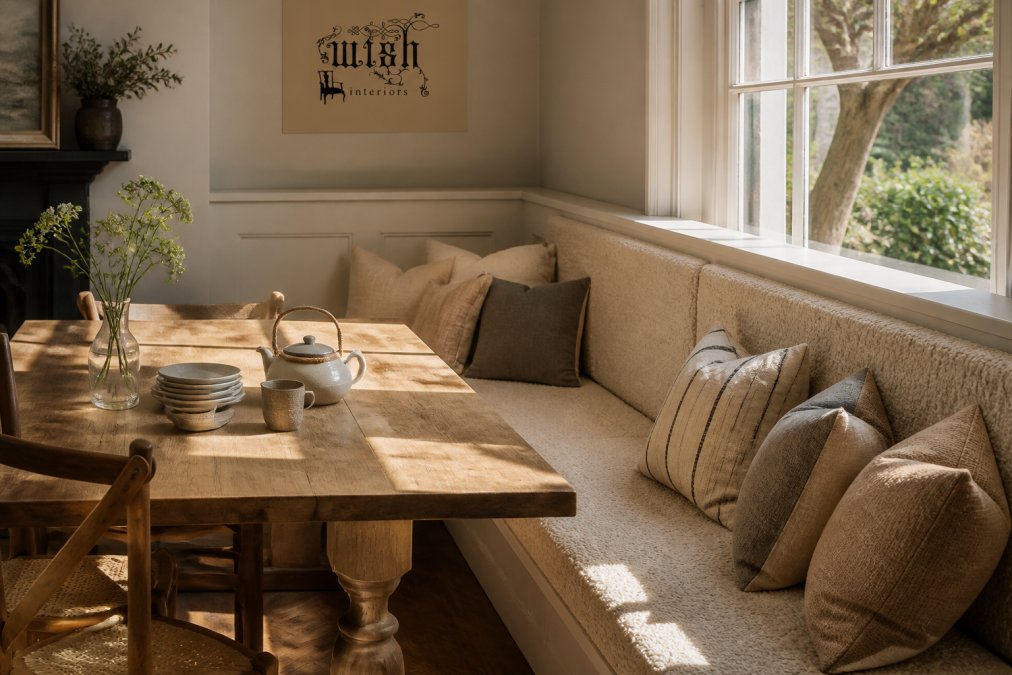
Stain-Resistant and Durable Upholstery Options
Stain-resistant upholstery is the practical choice for daily use, and the technology has improved considerably. Look for a tight weave with a factory-applied treatment rather than a spray you apply yourself, which wears off unevenly.
Farmhouse Dining Table With Bench and →
Small Kitchen Dining Solutions: Space-Saving Table Shapes
Small kitchen dining solutions live or die on table shape. A round table wastes less floor than a rectangular one in a tight corner, no sharp corners to walk into, and seats people evenly.
What Corner Bench Dining Tables Cost in 2026
Corner bench dining tables sit in a wide price band that reflects materials and whether the piece is made to measure. A solid wood table with a matching bench starts at £350.99; a larger farmhouse set with a bench runs £676.99; a waney edge table with a bench and metal legs sits at £620.99; and a fully custom set, made to your size and finish, runs to £1,211.99.
Styling and Caring for Your Corner Dining Nook
Styling a corner nook is mostly about restraint. The bench already fills the corner, so heavy furniture and busy patterns make the space feel closed in. Keep the table clear, use one or two cushions rather than a pile, and let the bench fabric carry the colour.
Ergonomic comfort: the numbers that decide whether anyone actually sits there
Most guides stop at looks. Comfort is a specification, and getting it wrong is the main reason a corner bench ends up as a dumping ground.
- Seat height. 45cm from floor to top of cushion is the standard dining height and matches most tables at 75cm. A bench at 43cm with a 75cm table leaves your knees high and your plate low; a bench at 48cm feels perched.
- Seat depth. 45cm to 50cm is the comfortable band for dining. Deeper than 55cm and shorter sitters cannot use the backrest; shallower than 40cm and the bench feels like a pew.
- Backrest angle. 100 to 105 degrees from the seat is the sweet spot for a dining bench. Upright (90 degrees) is fine for a five-minute breakfast and tiring over a long meal; reclined past 110 degrees and people slide forward to reach the table.
- Backrest height. 35cm to 45cm above the seat supports the lower back without blocking sightlines across an open-plan room.
- Legroom. Allow 30cm of clear depth under the table edge on the bench side. If the bench has a solid front panel, your shins hit it; a recessed plinth or an open frame solves this.
- Table-to-bench gap. Leave 25cm to 30cm between the front edge of the bench seat and the table edge so people can get in and out without the table digging into their thighs.
Long-term durability of upholstery: what actually wears out
Fabric choice is usually made on colour and texture. It should be made on wear, because a dining bench takes more abrasion than a sofa seat: people slide in and out, and the front edge of the cushion takes the brunt.
- Rub count (Martindale). This is the standard abrasion test used across the upholstery trade. Domestic seating generally specifies around 20,000 rubs for light use, 25,000 to 30,000 for general domestic, and 40,000-plus for heavy domestic or commercial. A family kitchen bench used daily sits at the top of the domestic band, so treat 30,000 as a floor, not a target.
- Boucle. The looped weave hides marks and feels substantial, but loops can snag on zips, belt buckles, and pet claws. It is a good choice for a low-traffic formal nook, less so for a bench where children climb on and off.
- Velvet and velour. Beautiful hand and depth of colour, but pile crushes and shows shading where people sit. It needs rotating and brushing, and it is unforgiving of spills.
- Suede and faux suede. Soft and warm, but water marks are permanent on many grades. Best kept to a dining room rather than a kitchen.
- Tight-weave linen and cotton blends. The most forgiving for daily family use, especially with a factory-applied stain treatment. Mid-tones hide the everyday marks that pale shades show.
- Performance weaves and coated fabrics. Tight synthetic or blended weaves with a factory finish are the practical choice for a bench that sees three meals a day. Avoid aftermarket sprays; they wear unevenly and can darken the fabric.
A realistic care routine
- Weekly: vacuum upholstery with a brush attachment; a crevice tool along the backrest seam stops debris building up.
- Spills: blot immediately with a clean cloth rather than rubbing, which pushes liquid deeper and spreads the stain.
- Rotation: rotate seat cushions every few months so front-edge wear is shared, and flip loose cushions if reversible.
- Sunlight: keep the bench out of direct sun where you can; even stain-resistant fabrics fade, unevenly where a cushion edge catches the light.
- Wood: wipe with a damp cloth and re-oil periodically. Avoid silicone polishes, which build up and dull the surface.
Frequently Asked Questions
What is a corner dining bench called?
A corner dining bench is most often called a banquette, or a corner banquette. In British kitchen design it is also referred to as a dining nook or breakfast nook. A banquette typically describes fixed or modular seating that runs along one or two walls, often with a corner return forming an L shape. Freestanding versions sit on legs and can be moved, while bespoke corner banquette seating is built in to fit the exact dimensions of your room.
How do you measure a space for a corner bench dining table?
Measure the full length of both walls where the bench will sit, then note the depth from the wall to any obstruction such as a radiator, door swing or kitchen unit. Allow 600 to 700mm of bench depth per person and 450 to 500mm of table width per diner. Leave at least 750mm of clear walkway behind the table. Always check the diagonal corner measurement too, because an L-shaped banquette has to clear both walls at once.
Are corner dining sets a good idea for small spaces?
Yes. A corner bench dining table removes the need for chairs behind the table, which frees up roughly 900mm of floor space on that side. In a compact kitchen diner or open-plan living room, this is often the difference between fitting a four-seat table and not fitting one at all. Bench seating also gives you hidden storage underneath, which helps in flats where cupboard space is tight.
What materials are best for durable, high-traffic dining benches?
For the table, solid wood tops in oak, walnut or ash handle daily use and can be sanded back if scratched. For the bench, look for tightly woven boucle, suede fabric or a stain-resistant upholstery with a rub count above 25,000 cycles for residential use. Higher rub counts suit commercial settings such as hotel dining rooms. Wish Interiors offers custom size and finish dining sets at £1,211.99, and farmhouse table and bench combinations from £350.99.
Sample Image Gallery


