





Custom Upholstery for Awkward Shaped Vintage Sofas
Table of Contents
- Why Awkward Shaped Vintage Sofas Need a Different Approach
- How to Measure a Sofa for Reupholstery When the Shape Is Irregular
- Choosing Upholstery Fabric for Curved Sofas and Angled Arms
- Foam, Padding and Batting Specifications for Unusual Shapes
- Reupholstery Cost for a Vintage Sofa: Budgeting and Lead Times
- Vintage Sofa Upholstery Ideas That Preserve Original Character
- DIY vs Professional Upholstery for Complex Vintage Sofas
- Conclusion
- Frequently Asked Questions
Last Updated: October 8, 2026
Why Awkward Shaped Vintage Sofas Need a Different Approach
Custom upholstery for awkward shaped vintage sofas is not a job you can solve with a standard cushion and a staple gun. That is why so many vintage pieces sit untouched in spare rooms, waiting for someone to take them seriously.

At Wish Interiors, we have spent over 60 years working with exactly these shapes, and the lesson is simple: an irregular vintage frame needs a pattern cut to it, not a cushion squeezed onto it.
Below, we break down how to measure, specify, budget and fit custom upholstery for awkward shaped vintage sofas, step by step.
How to Measure a Sofa for Reupholstery When the Shape Is Irregular
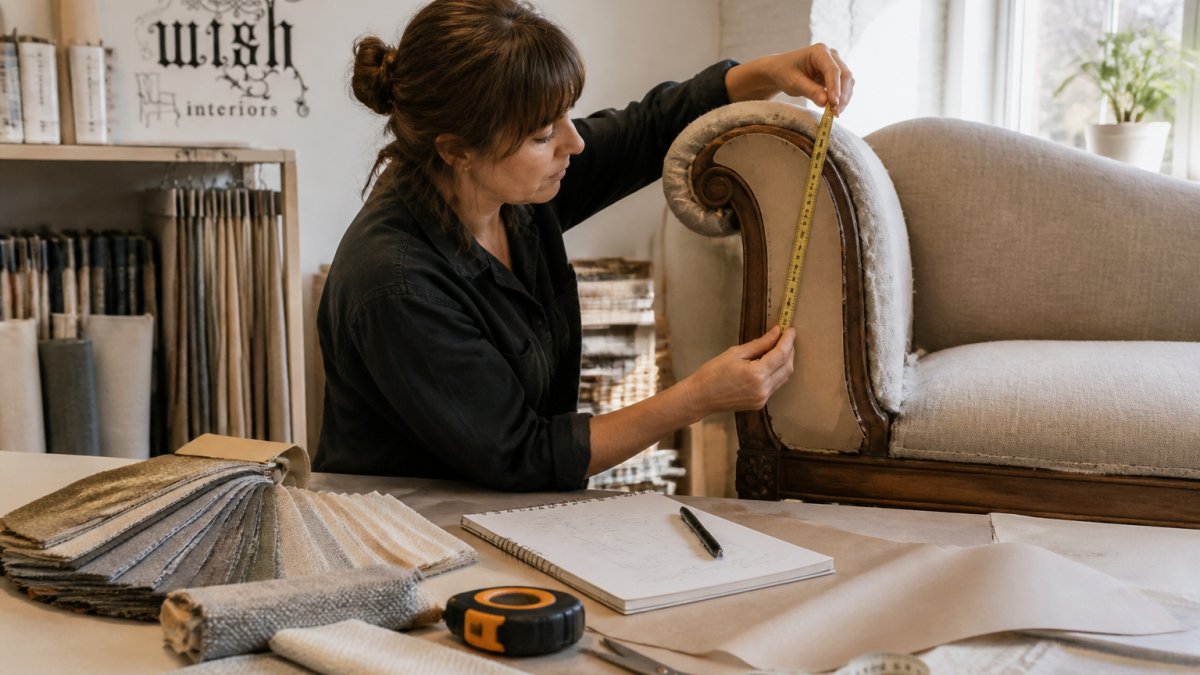
Measuring a sofa for reupholstery starts with the frame, not the old fabric. Strip the piece back, or work from the bare frame if it is already stripped, and record every surface the new cover will touch.
You need four core measurements:
- Seat width at the front edge, the middle and the back
- Seat depth at both ends and the centre
- Back height at each corner, not just one
- Arm profile traced on paper from the outside face
Take each measurement three times and write down all three. On a curved sofa the numbers will differ, and that difference is the whole point.
Documenting Curves, Angles and Asymmetry
Curves and angles need a physical template, not just numbers. Cut a paper or card template of the arm face, the back curve and any scroll. Label each template with which side it belongs to.
Then photograph the frame from six angles and note anything unusual:
- A back that leans more on one side
- Arms at different heights
- A seat that tapers front to back
Keep the templates and photos with the measurements. Any upholsterer worth using will ask for them.
Choosing Upholstery Fabric for Curved Sofas and Angled Arms
Upholstery fabric for curved sofas needs stretch, recovery and a pattern that can be matched across a bend. Tight, stiff weaves fight a curve and wrinkle at the seam. A fabric with a little natural give follows the shape and holds it.
What works well on irregular frames:
- Wool and wool blends for recovery and durability
- Velvet and velvet-touch fabrics for softness over curves
- Linens and linen mixes for a relaxed vintage look
What to avoid on a curved or angled frame:
- Large repeat patterns that cannot be centred
- Heavy, board-stiff fabrics with no give
- Stripes that must run perfectly straight
Order a sample and drape it over the actual curve before you commit. A fabric that looks right flat can behave very differently once it bends.
Foam, Padding and Batting Specifications for Unusual Shapes
Upholstery foam for an irregular frame must be cut to the template, not ordered in a standard block. High-density foam holds its shape on a curved seat far better than soft foam, which collapses at the edges first.
For most vintage sofas, we suggest:
- High-density foam for seat cushions, cut to the seat template
- Medium foam for back cushions, where comfort matters more than support
- Polyester batting wrapped over the foam to soften edges
Foam firmness is a personal choice, but on an awkward shape, firmer is safer. Soft foam shows every gap and dip in the frame underneath.
When to Choose Custom Foam, Replacement Cushions or Full Reupholstery
Not every vintage sofa needs the same level of work. Use this to decide:

| Option | Best For | Typical Effort | Keeps Original Frame |
|---|---|---|---|
| Custom foam only | Firm frame, worn cushions | Low | Yes |
| Replacement cushions | Good frame, tired seats | Low to medium | Yes |
| Partial reupholstery | One damaged section | Medium | Yes |
| Full reupholstery | Worn cover, sound frame | High | Yes |
| Full rebuild | Broken frame or springs | Highest | Sometimes |
If the frame is solid, custom foam or replacement cushions solve most problems. If the cover is torn, sagging or stained throughout, full reupholstery is the honest answer.
Reupholstery Cost for a Vintage Sofa: Budgeting and Lead Times
Reupholstery cost for a vintage sofa depends on the shape, the fabric and the labour, but an awkward frame changes the maths in ways a rectangular sofa never does. Curves, tapers and asymmetric arms mean more patterning time, more fabric waste and more fitting hours, so the same fabric on the same metreage can cost noticeably more to install.
There is no single figure that fits every piece, but a transparent breakdown helps you plan. Budget for these parts:
- Fabric by the metre, plus an extra 10-20% for pattern matching across curves and seams
- Foam and padding, cut to your templates rather than bought in standard blocks
- Labour, which rises with curves, tufting, piping and hand-stitching
What Drives the Price Up on an Awkward Shape
A simple rectangular sofa is largely a cutting-and-stapling job. An irregular vintage frame adds three cost multipliers:
- Patterning time. Each curve, scroll and angled arm needs its own template, cut and test-fitted. On a complex piece this can add several hours before any fabric is touched.
- Fabric waste. Large repeats and directional patterns cannot be centred on a curved back, so you buy more metres than the surface area suggests.
- Fitting time. Stretch fabrics follow a bend; stiff ones must be eased, steamed and pinned by hand. That is skilled labour, not machine time.
As a rough planning guide, most upholsterers price a full reupholstery on a standard two-seater in the low-to-mid four figures, with awkward vintage frames, deep tufting or extensive frame repair pushing toward the upper end. Custom foam cut to template is usually the cheapest way to improve comfort without stripping the whole piece.
HOMCOM Loveseat with Wood Frame, Compact 2 Seater Sofa, Button Tufted Chaise →
Lead Times: What to Expect
Bespoke work takes longer than off-the-shelf, and a complex vintage frame sits at the top of that range. A common pattern is:
- Custom foam or replacement cushions: days to a couple of weeks, depending on template complexity
- Partial reupholstery: two to four weeks
- Full reupholstery of an awkward vintage sofa: four to eight weeks, longer if frame repairs or specialist fabric orders are involved
Ask for a written timeline before you commit, and build in a buffer if you have a deadline. Fabric mills can add weeks if your chosen cloth is out of stock, and frame repairs often reveal themselves only once the old cover is off.
Vintage Sofa Upholstery Ideas That Preserve Original Character
Vintage sofa upholstery ideas should protect what makes the piece worth keeping. The frame, the legs, the springs and the silhouette carry the character. The fabric is where you get to play.
Ideas that work:
- Match the original fabric type where you can find it
- Keep the original wooden legs and frame finish
- Reuse the spring and webbing layout rather than replacing it
Tufting, Piping and Structured Details
Tufting, piping and structured details are what separate a good vintage restoration from a plain recover. Deep button tufting adds depth to a back or seat and suits traditional frames. Piping sharpens the edges of arms and cushions. Structured upholstery keeps the shape firm where the frame is irregular.
These details take time, and they cost more. They also lift a piece from ordinary to genuinely special.
DIY vs Professional Upholstery for Complex Vintage Sofas
DIY reupholstery can work on a simple, square sofa with a sound frame and removable cushions. On a complex vintage piece with curves, angles and old springs, it usually ends in tears, not because the skills are unlearnable, but because the margin for error is tiny and the materials are unforgiving.
The Tools and Skills a Complex Job Demands
A basic DIY recover needs a staple gun, tack lifter, scissors and a sewing machine. An awkward vintage sofa adds:
- Template-making materials, card, lining paper or template plastic for curved arms and backs
- A long-arm or walking-foot sewing machine for piping, welting and heavy fabrics
- Curved needles for hand-stitching around scrolls and tight corners
The harder skill is not sewing, it is patterning. A wrong cut on a curved back cannot be undone, and fabric is rarely returnable once cut.
Complexity Thresholds: When to Hire
Use these thresholds as a practical guide:
| Your Sofa | DIY Feasible? | Why |
|---|---|---|
| Square frame, removable cushions, sound springs | Yes | Straight cuts, standard seams |
| Slightly angled arms, simple back | Maybe | Manageable with templates and patience |
| Curved or asymmetric arms | No | Patterning errors are costly and visible |
| Deep button tufting | No | Requires specialist tools and years of practice |
| Original springs needing repair | No | Frame work risks damaging the piece |
| Frame that needs strengthening | No | Structural work should be assessed professionally |
If your sofa sits in the bottom four rows, professional work is usually cheaper in the long run. An upholsterer cuts once, fits once and gets it right, and they carry the risk if the fabric behaves badly.
The Risks of Getting It Wrong
On a one-off vintage piece, the risks are not just financial. A mis-stapled frame can split old timber. A poorly tensioned cover can pull the frame out of shape.
For anything genuinely awkward, treat DIY as a learning project on a cheap practice chair, not on the vintage sofa you actually care about.
If you would rather not gamble on a one-off vintage piece, our team handles bespoke upholstery guidance from the Association of Master Upholsterers and Soft Furnishers, and we can take on the whole job from collection to delivery.
Conclusion
Awkward shaped vintage sofas are worth the effort, but they punish guesswork. Measure the frame properly, template every curve, choose fabric and foam that suit the shape, and budget for the labour a complex piece demands.
At Wish Interiors, our family-run workshop brings over 60 years of bespoke craftsmanship to every project, from custom foam cut to your templates to full handmade reupholstery.
Call 020 46202525 to discuss your vintage sofa, and we will help you bring it back to life.
Frequently Asked Questions
Can an awkward-shaped vintage sofa be reupholstered?
Yes. Curved backs, angled arms and asymmetric frames are all candidates for custom upholstery. The key is accurate measurement and a pattern that follows the original shape rather than forcing a standard cover onto it. A professional upholsterer will often create a paper template of each panel before cutting fabric. This approach preserves the vintage silhouette and ensures a custom fit. If the frame is solid and the springs are sound, reupholstery is usually worthwhile.
How much fabric is needed to reupholster a vintage sofa?
Fabric quantity depends on the sofa size, shape complexity and pattern repeat. A standard two-seater typically needs around 8 to 10 metres, while a three-seater with curved arms or a high back can require 12 to 15 metres. Sofas with deep button tufting or large pattern repeats need extra allowance. Always buy at least 10 per cent more than calculated to cover matching and future repairs. Your upholsterer should confirm exact metreage after measuring.
Is it worth reupholstering an old vintage sofa?
It often is, particularly when the frame is solid wood and the piece has sentimental or design value. A well-made vintage frame frequently outlasts modern equivalents. Reupholstery lets you keep the original shape, choose high-density foam for comfort and select a fabric that suits your interior. For a sofa with a sound frame, the result is a bespoke piece at a fraction of the cost of a comparable new commission. Inspect the frame and springs first.
How long does custom sofa upholstery take?
Lead times vary with project complexity and fabric availability. Simpler reupholstery jobs can take two to four weeks, while awkward-shaped vintage sofas with tufting, curved panels or specialist fabric orders often take six to ten weeks. Bespoke pieces made from scratch, such as the Kovacs Three Seater Sofa, are delivered around six weeks. Always confirm the timeline before committing, especially if you are coordinating with a renovation schedule.
Sample Image Gallery


