





Traditional vs Modern Upholstery for Luxury Chairs
Table of Contents
- Traditional vs Modern Upholstery for Luxury Chairs: Key Differences
- What Traditional Upholstery Means
- What Modern Upholstery Means
- Upholstery Materials for Luxury Chairs: Natural Fillings vs Foam
- Support Systems: Springs, Webbing and Seat Padding
- Hand Craftsmanship, Labour Intensity and Time to Complete
- Reupholstering Antique Chairs: Which Method Protects the Frame
- Chair Reupholstery Cost and Lifecycle Value
- Which Upholstery Method Suits Your Chair?
- Frequently Asked Questions
Last Updated: October 9, 2026
Traditional vs Modern Upholstery for Luxury Chairs: Key Differences
Choosing luxury chair upholstery, traditional or modern, comes down to one question: do you want a seat built to be repaired for a century, or one built to feel plush from day one?
In luxury chair upholstery, a hand-built seat and a foam seat can look identical in a showroom and behave completely differently after five years of daily use.
What Traditional Upholstery Means
The sequence rarely changes: webbing is stretched across the frame, springs are tied in place, and fillings are stitched down before the fabric goes on. A skilled upholsterer controls the tension at each stage, which is why two chairs built to the same pattern can still feel different.
- Frame prepared and webbed by hand
- Springs tied and lashed with twine
- Natural fillings layered and stitched
That layered build gives traditional seating its resilience, and means the chair can be rebuilt later rather than replaced.
What Modern Upholstery Means
Foam arrives in blocks or moulded shapes and is cut to size, so a seat cushion can be produced in minutes rather than hours.
Modern methods deliver predictable softness and lower labour, but the seat is harder to rebuild once the foam compresses, which matters for a chair you plan to keep for decades.
Upholstery Materials for Luxury Chairs: Natural Fillings vs Foam
Material choice drives how the chair feels, ages and can be restored.
| Material | Method | Feel | Repairability |
|---|---|---|---|
| Horsehair | Traditional | Firm, springy | High, can be re-teased |
| Straw and seagrass | Traditional | Firm base layer | High, replaced in sections |
| Coil springs | Traditional | Responsive, supportive | High, re-tied by hand |
| Foam | Modern | Soft, uniform | Low, usually replaced whole |
| Polyester fibre | Modern | Light, lofty | Low, compresses over time |
Horsehair, Straw and Seagrass in Traditional Construction
Horsehair is the defining traditional filling. It is teased, curled and stitched into place so it holds its loft for decades, and it breathes in a way foam does not.
These natural fibres are why a well-built antique chair can still feel supportive after a hundred years, and they can be re-teased or topped up during reupholstery rather than thrown away.
Foam and Polyester Fibre in Modern Construction
Foam gives a soft, even seat from the first day, and polyester fibre fills backs and cushions cheaply. Both are consistent and quick to fit, which is why most mass-produced seating uses them.
The limitation is compression: foam loses height and support over years of use, and once it collapses the usual fix is replacement, not repair.
Support Systems: Springs, Webbing and Seat Padding
The support system decides how a chair feels under you, and it is the clearest difference between the two methods, and the part buyers are least able to see.
Hand-Tied Springs and the Load Path
In a hand-tied seat, coil springs are lashed to the frame with twine and tied again in several directions so the coils share load rather than acting alone.
That distribution protects the frame: because the springs flex slightly under load, the joints are not asked to absorb the full force of someone sitting down.
Webbing, Elastic Webbing and Sinuous Springs
Traditional webbing is a woven jute or linen strip stretched across the frame and tacked under tension.
Modern construction usually replaces it with one of two systems. Elastic webbing is a rubberised strip stretched across the frame, quick to fit and cheap to replace, but it loses tension over time.
Foam as a Support System
Foam upholstery replaces the whole sprung assembly with a single block or a layer over elastic webbing. It is comfortable, predictable and uniform from the first day, but it cannot be re-tensioned: when the foam softens, the seat sags and the only fix is replacing the cushion.
What to Check When You Sit
A few practical tests tell you more than a showroom description:
- Push back test: if the seat pushes back slightly as you settle, you are almost certainly on hand-tied springs. If it sinks and stays, it is foam or elastic webbing.
- Edge test: press the front edge of the seat. A sprung edge with a stitched hair layer resists and recovers; a foam edge compresses and stays compressed.
- Sound test: a hand-tied seat is quiet under load. Creaks or clicks often point to a loose frame or tired webbing rather than the filling.
Matching Support to the Chair's Role
A formal chair used occasionally can carry a firm traditional build without any comfort penalty.
The support system and the frame should be chosen together. A hand-tied seat on a light frame can stress joints it was never designed for, and a rigid foam seat on an antique frame can do the same.
Hand Craftsmanship, Labour Intensity and Time to Complete
Hand craftsmanship is the biggest hidden cost in traditional upholstery, and the reason it takes hours or days rather than minutes. A skilled upholsterer builds one chair at a time, and each stage depends on the last.
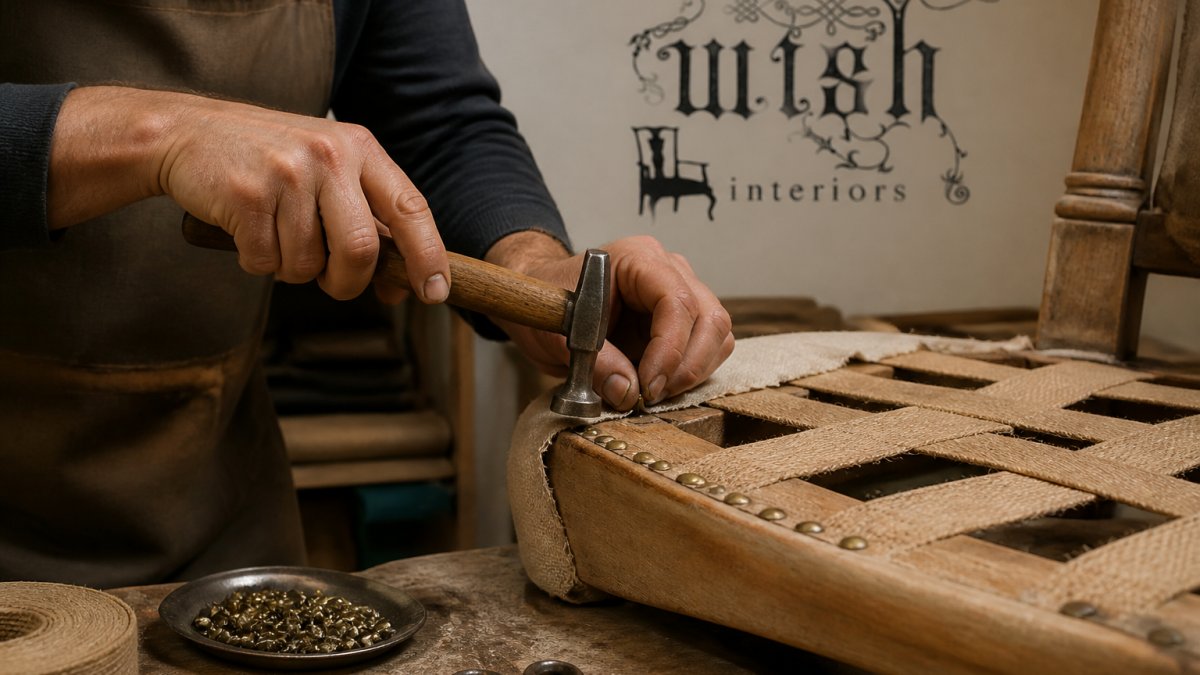
Stripping an old chair, re-webbing, tying springs and stitching fillings can take a full day before any fabric is cut.
Stitching, Tacking and Deep Buttoning by Hand
Deep buttoning is the clearest example of labour intensity. Each button compresses the filling beneath it, and the upholsterer works across the back in a set order so the tension stays even.
Tacking and stitching follow the same logic. Fabric tension is set by hand, which is why a traditional seat holds its shape and a loosely built one ripples within a year.
HOMCOM Recliner Armchair, Vintage Reclining Chair with Nail Head Trim, Wingback →
Reupholstering Antique Chairs: Which Method Protects the Frame
For antique and period furniture, traditional methods protect the frame and modern methods can damage it.
Fit a rigid foam block instead and the load path changes. Stress moves to joints that were never designed to take it, and over time the frame works loose.
There is also a value argument.
Chair Reupholstery Cost and Lifecycle Value
Traditional reupholstery costs more up front because it takes far more labour, but the useful comparison is not the first invoice. It is the cost per decade of comfortable use, and that depends on what can be repaired rather than replaced.
What Actually Drives the Cost
Upholstery quotes vary because the work varies. The main drivers are:
- Frame condition. A sound frame needs cleaning and minor tightening. A loose frame needs joints re-glued and clamped, which adds labour before any upholstery begins.
- Filling replacement. Re-teasing existing hair is cheaper than replacing it. If the hair has broken down or the springs are tired, the seat has to be rebuilt from the base up.
- Spring work. Re-tying existing coils is quicker than replacing them. Replacing a full set of hand-tied springs is a significant part of any traditional quote.
This is why an honest quote needs the chair in front of the upholsterer. A figure given over the phone is a guess, not an estimate.
Rebuild Intervals and Repairability
A traditionally built chair is designed to be opened up and rebuilt. In practice, the frame and springs often outlast several covers, and the fillings can be topped up or re-teased rather than discarded.
A foam seat behaves differently. The foam is the support system, so when it compresses the seat has to be replaced rather than repaired, no re-tensioning, no re-teasing, no partial fix.
A Lifecycle Comparison
Rather than comparing two price tags, compare what happens over a long ownership period:
| Stage | Traditional build | Foam build |
|---|---|---|
| First build | Higher labour and material cost | Lower labour and material cost |
| Mid-life | Fillings re-teased, springs re-tied, cover replaced | Foam cushion replaced, or chair replaced |
| Late life | Frame and springs reused again | Frame often discarded with the seat |
| Residual value | Retains character and market value | Limited once the seat has gone |
The pattern is consistent: the traditional chair costs more to start and less to keep, while the foam chair costs less to start and more to keep. Which wins depends on how long you intend to keep the chair.
Repair Options Worth Knowing
Not every problem needs a full rebuild. Common repairs include re-tensioning or replacing webbing, re-tying loose springs, re-teasing and topping up hair, replacing a single cushion, and re-covering without touching the fillings. A good upholsterer will tell you which your chair actually needs rather than quoting for the maximum.
How Hybrid Construction Blends Both Methods
Hybrid construction uses a traditional frame and sprung base with modern foam in the seat cushion. It is the pragmatic middle ground, and what we specify most often for busy family homes and hospitality seating.
The logic is that springs and webbing carry the structural load and can be re-tensioned, while the foam cushion delivers the softness most people want today.
Which Upholstery Method Suits Your Chair?
Match the method to the chair's role, not to a preference for old or new:
- Antique or period chair: traditional methods, to protect the frame and preserve value.
- Everyday family seating: hybrid construction, sprung base with foam cushions.
- Formal or occasional chair: traditional build, since wear is light and longevity is the point.
One more consideration: fabric choice and compatibility. A heavy weave suits deep buttoning and holds tension well, while a light fabric over a foam seat can look tired quickly. The material and the method should be chosen together.
At Wish Interiors, our Classic C02 Armchair in green leather and wood shows how a solid wood frame and stain-resistant, water-resistant leather work with either approach, and our Hoxton brown leather Chesterfield sofa pairs classic tufted upholstery with a modern silhouette.

If you want the vintage look with modern comfort built in, the HOMCOM recliner armchair in dark grey uses a strong wooden frame, thick sponge padding and a tufted back, with a manual recline to 150 degrees and a maximum load of 150kg. For a traditional frame with a modern seat, our Classical Kennedy dining chair in dark oak combines a solid oak frame with a soft PU leather seat.


Frequently Asked Questions
What is the difference between traditional and modern upholstery?
Traditional upholstery builds support from the frame up using hand-tied coil springs, webbing and natural fillings such as horsehair, straw or seagrass, fixed with stitching, tacking and deep buttoning. Modern upholstery relies on foam and polyester fibre over a webbed or sprung base, shaped with machine-cut covers. Traditional methods are labour-intensive and take hours or days to complete, while modern methods are faster and more uniform. Many luxury chairs now use hybrid techniques that combine a hand-built foundation with foam seat padding for everyday comfort.
Are traditional upholstery techniques more durable than modern methods?
Not automatically. A hand-tied spring unit with natural fillings can be retied and refilled repeatedly, which is why traditional construction often lasts decades in period furniture. Foam, by contrast, compresses over time and is usually replaced rather than repaired. Durability depends on the chair frame, fabric tension and how the piece is used. For a chair sat in daily, a hybrid build with hand-tied springs under a foam seat often gives the best balance of comfort and longevity.
Is foam upholstery suitable for a luxury chair?
Yes, when the foam density and seat padding are specified properly. High-density foam holds its shape well and suits modern silhouettes where a crisp, uniform finish matters. The limitation is repairability: foam degrades and is normally swapped out rather than restored, so a foam-only chair has a shorter service life than one built on springs. For luxury chairs used daily, foam over a sprung base is a practical middle ground.
How do you choose between traditional and modern upholstery for an antique chair?
Match the method to the chair's age and frame. Antique and period furniture usually keeps its value when reupholstered with traditional methods, because hand-tied springs, webbing and natural fillings sit correctly on an old frame and stay reversible. Modern foam can put uneven pressure on fragile joints. If the antique chair is a daily-use piece, a hybrid approach, traditional support with a foam seat layer, protects the frame while improving comfort.
Can traditional upholstery be combined with modern materials?
It is common practice. Hybrid construction pairs a hand-built foundation, such as hand-tied coil springs on a webbed base, with modern foam and polyester fibre in the seat and back. This keeps the repairability and hand craftsmanship of traditional methods while gaining the shape retention and faster completion times of modern materials. The right mix depends on how often the chair is used and whether you want the crunchy feel of natural fillings or a firmer, more uniform seat.
The real challenge is not choosing between old and new, but finding someone who can build the right one for your chair and your room. Wish Interiors has over 60 years of bespoke craftsmanship behind every piece, from custom upholstery and printed sofas to limited edition chairs, all handmade and tailored to your space. We work with homeowners, interior designers and hospitality projects alike, and you can spread the cost with Klarna. Call 020 46202525 to discuss your chair and get started.
Sample Image Gallery


