





Handcrafted vs Mass-Produced Furniture: Real Differences
Last Updated: October 22, 2026
Quick Summary
Handcrafted furniture is built piece by piece by a skilled maker using solid timber and traditional joinery, while mass-produced furniture is turned out in volume on factory lines, usually from veneered board and machine-cut joints. The practical difference shows up in how long the piece lasts, whether it can be repaired, and what it truly costs you over ten or twenty years.
- Ask who decided how a joint fits: a named maker means handcrafted work.
- Solid wood means timber through and through, but ask which parts.
- Dovetail and mortise-and-tenon joints interlock timber and signal hand fitting.
- Solid timber frames can be re-glued, sanded and refinished; swollen board cores cannot.
- The lifetime case for handcrafted furniture weakens for lightly used or temporary pieces.
Table of Contents
- Handcrafted Furniture vs Mass-Produced: The Short Answer
- What Handcrafted and Mass-Produced Actually Mean
- Mass-Produced Furniture Materials vs Solid Wood
- Joinery, Craftsmanship and Build Quality
- Solid Wood Furniture Durability and Quality Consistency
- Furniture Lifespan and Repairability: The Long View
- Bespoke Furniture Cost and Lifetime Value
- How to Verify a Piece Is Genuinely Handcrafted
- Frequently Asked Questions
Handcrafted Furniture vs Mass-Produced: The Short Answer
Handcrafted furniture is built piece by piece by a skilled maker using solid timber and traditional joinery, while mass-produced furniture is turned out in volume on factory lines, usually from veneered board and machine-cut joints. The practical difference shows up in three places: how long the piece lasts, whether it can be repaired, and what it truly costs you over ten or twenty years.
What Handcrafted and Mass-Produced Actually Mean
Handcrafted furniture is furniture where a maker selects, cuts, shapes and assembles the piece, often to order, with hand tools and traditional techniques guiding the work. Mass-produced furniture is furniture manufactured in high volumes on fixed production lines, where each unit is identical and speed sets the design.
Where the line really sits
The line is not "no machines versus all machines." A genuine workshop uses planers, saws and sanders. The distinction is who makes the decisions: in a handcrafted piece, a person reads the grain, adjusts the joint and finishes the surface; on a production line, a jig and a template do that work. That single difference explains almost everything that follows.
Mass-Produced Furniture Materials vs Solid Wood
Mass-produced furniture materials are typically particleboard or MDF wrapped in a thin veneer or foil, while handcrafted pieces are usually built from solid wood. Veneer and foil hide what sits underneath, and what sits underneath decides how the piece ages.
How to read a materials label
Manufacturers use specific words, and each one tells you something:
- "Solid wood" means the structural parts are timber through and through. Good sign, but ask which parts.
- "Solid wood with veneers" means a solid core with a veneer surface. Honest, and often sensible for large panels.
- "Wood veneer" alone usually means a board core under a thin timber layer.
Our Minimalist Mango Wood Oslo Bedside Table is a useful reference point: handcrafted from kiln-dried mango wood with a light oak finish, and the natural grain runs differently on every unit. That variation is the signature of solid timber. A printed foil repeat is the signature of the opposite.


Joinery, Craftsmanship and Build Quality
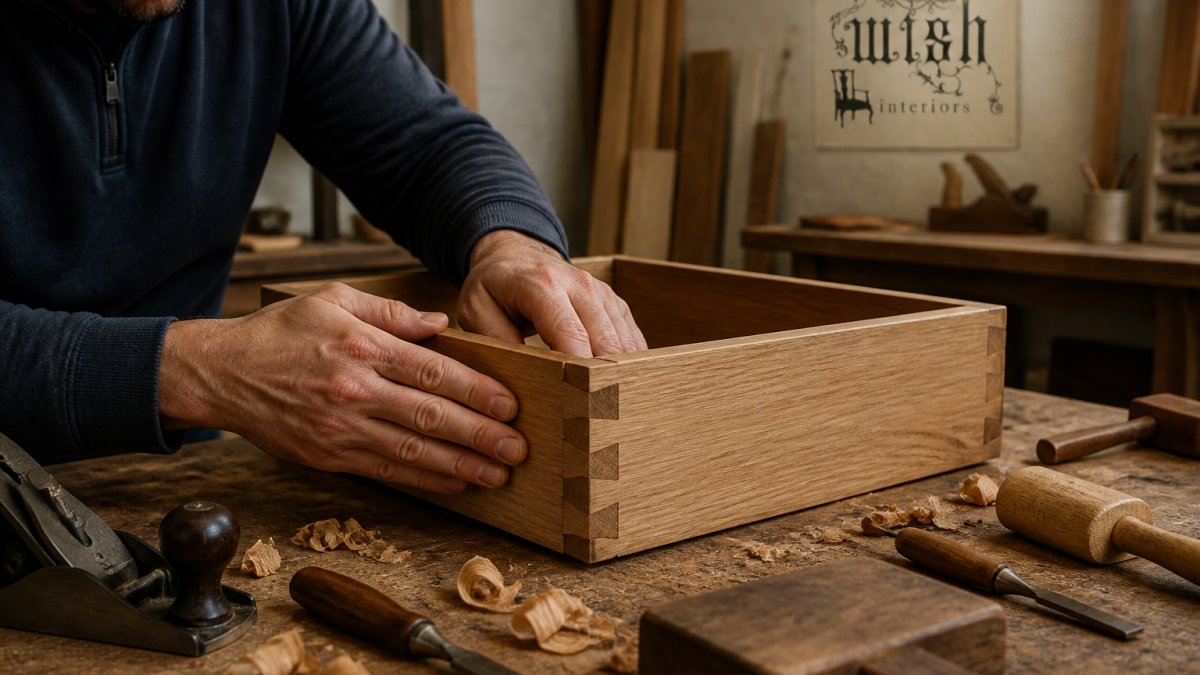
Traditional joinery is the clearest tell of craftsmanship, because it costs time and skill that production lines avoid. A dovetail or mortise-and-tenon joint interlocks timber into timber.
A glued and jointed frame distributes load across the timber, while a cam fitting concentrates stress at a small drilled point, and particleboard around that point crumbles once it loosens.
Solid Wood Furniture Durability and Quality Consistency
Solid wood furniture durability comes from repairable construction and timber that can be refinished, while mass-produced consistency comes from identical factory output. These are different virtues, and buyers often confuse them.
Quality consistency cuts both ways. A factory can produce a thousand identical units, useful for a hotel fitting forty identical rooms.
Our Scandinavian Walnut Oslo Console, Dressing Table, and Desk shows the trade: solid wood with no veneer, handcrafted and unique, and versatile enough to serve as a desk, hallway table or dressing table.

Furniture Lifespan and Repairability: The Long View
Furniture lifespan and repairability are where the two categories diverge most sharply. A cared-for solid timber piece can be refinished and reupholstered repeatedly, while a veneered board unit usually dies the first time a joint fails or a surface lifts.
What can realistically be repaired
- Solid timber frames: joints can be re-glued, surfaces sanded and refinished, legs re-tightened.
- Upholstered pieces: foam, webbing and covers can be replaced, which is exactly the work our family workshop has done for over 60 years.
- Veneered board: a lifted edge can sometimes be glued, but a swollen or crumbling core cannot be rebuilt.
That is why we offer reupholstery and restoration alongside new pieces. A quality sofa or chair is rarely finished; it is usually just tired.
Bespoke Furniture Cost and Lifetime Value
Bespoke furniture cost is higher at the till and often lower over time, because the purchase price is only the first payment. A transparent comparison needs stated assumptions, a worked example and a clear list of what is excluded, so you can substitute your own numbers.
The assumptions behind any fair comparison
Lifetime cost depends on four variables, and every one of them should be written down before you compare two pieces:
- Purchase price, including delivery and assembly.
- Expected service life under your actual use, not a best-case figure.
- Repair and refurbishment spend across that life, including labour and parts.
A comparison that omits delivery, assembly or disposal flatters whichever option is replaced more often. State the assumptions and the conclusion usually changes.
A worked example you can adapt
Take a bedside chest used daily in a household of two adults. The figures below are illustrative placeholders, not quotes: replace them with prices you have actually been given.
Minimalist Mango Wood Oslo Bedside Table →
| Cost line | Mass-produced (illustrative) | Handcrafted (illustrative) |
|---|---|---|
| Purchase price | £180 | £650 |
| Delivery and assembly | £25 | Included |
| Expected service life | 5 years | 20 years |
| Replacements over 20 years | 3 further units | None |
| Repair spend over 20 years | £0 (not economic to repair) | £90 (one re-glue and refinish) |
| Disposal and redelivery per replacement | £30 | £0 |
| Indicative 20-year total | £180 + £25 + 3 × (£180 + £25 + £30) = £910 | £650 + £90 = £740 |
The arithmetic is deliberately simple. The point is not that handcrafted always wins; it is that the gap narrows sharply once replacement frequency, delivery and disposal are counted.
Where the comparison can flip the other way
Handcrafted furniture is not automatically the cheaper option over time. The lifetime case weakens when:
- The piece is used lightly or temporarily, such as in a rental or a short-term let.
- The room layout is likely to change, so a made-to-measure piece may not fit the next home.
- The handcrafted piece is bought for a look rather than for daily hard use.
A mass-produced piece bought for a spare room used a few times a year may never need replacing, so the lower upfront price is rational. The lifetime argument is strongest for pieces used daily and kept for a decade or more.
What to ask each supplier
When comparing quotes, ask for the replacement cost of specific components: drawer runners, cushion foam, covers and hardware. A maker who can quote those numbers is a maker whose furniture can actually be kept alive. Also ask, in writing:
- What the lead time is and what happens if it slips.
- Whether delivery, assembly and packaging removal are included.
- What the warranty covers and for how long.
Klarna is available at checkout if spreading the cost helps your renovation budget.
How to Verify a Piece Is Genuinely Handcrafted
Verification is mostly a matter of asking precise questions and looking at specific details, not trusting a label. "Handmade" has no legal definition in general retail use, so the burden sits with you.
Ask about machine-made components
Almost every workshop uses machines; the question is which ones and for what. A genuine maker will usually say timber is planed and thicknessed by machine, parts are cut to size by machine, and the fitting, jointing and finishing are done by hand. A production line will say jigs and templates set the joint and the operator feeds material through.
Inspect the joinery, not the finish
Finish is the easiest thing to fake and the least useful thing to judge. Open a drawer and look at the corner where the side meets the front:
- Dovetail or mortise-and-tenon joints interlock timber into timber and are the clearest sign of hand fitting.
- Cam-and-dowel fittings rely on a metal bolt tightened into a drilled hole; they concentrate stress at a small point.
- Staples, screws into board edges and glued blocks are common in volume production and are the first things to fail under load.
Run a finger along the inside of a joint. A hand-fitted joint is usually tight and slightly irregular; a machined joint is uniform but may show a gap where the board has shrunk. Check the underside and the back, where finishing is often skipped on cheaper pieces.
Check what is under the surface
Veneer and foil hide the core, and the core decides how the piece ages. Look for an exposed edge, an open drawer bottom or a fixing point where the material is visible:
- Solid timber shows end grain and continuous grain around the edge.
- Veneered board shows a thin timber layer over a core, often visible at an edge or where a fixing has been made.
- Foil-wrapped board shows a plastic-like wrap that splits rather than dents.
Ask which parts are solid and which, if any, are veneered. Honest makers distinguish between a solid frame and a veneered panel, and will say so.
Confirm maker involvement and lead time
Ask who makes the piece and how long it takes. A named maker and a stated lead time are stronger signals than any label. For anyone specifying a full room, our Minimalist Mango Wood Light Oak Oslo Chest of 3 Drawers is built from kiln-dried solid wood with no veneers, and arrives predominantly assembled, removing one common source of damage.
The checklist
- Ask where the timber is sourced and whether it is kiln-dried.
- Ask which parts are solid and which, if any, are veneered.
- Look inside a drawer for interlocking joints rather than metal cams.
Trade-offs exist beyond price and durability, too: handcrafted pieces carry a lead time, and no two are identical, which some buyers love and others find unnerving. On sustainability, repairable furniture generally keeps materials in use longer, though timber sourcing claims deserve the same scrutiny as any other. Guidance from WRAP on extending product life and the Forest Stewardship Council on certified timber is worth reading before you accept an environmental claim at face value.
Frequently Asked Questions
Is handcrafted furniture better quality than mass-produced furniture?
Not automatically. Quality depends on the maker, the timber and the joinery, not the label. Handcrafted furniture usually gives you thicker solid wood, traditional joinery and a maker who can adjust or repair the piece later. Mass-produced furniture can be well engineered, but it often uses particleboard or thin veneers and glued or stapled joints that are hard to fix. Inspect the joints, drawer runners and timber edges before you decide, and ask what happens if a part fails in five years.
Is custom-made furniture more expensive than buying off the shelf?
The purchase price is usually higher, because one piece carries the full cost of skilled labour, solid timber and a made-to-order process rather than being spread across thousands of identical units. Bespoke furniture cost also covers design time, fittings and often delivery and installation. The comparison shifts over time: a solid wood piece that can be reupholstered and refinished may be cheaper per year of use than replacing a cheaper item two or three times.
How long does handcrafted furniture last compared with mass-produced furniture?
There is no fixed number, and any claim of a guaranteed lifespan should be treated with caution. What matters is furniture lifespan and repairability: solid wood frames with traditional joinery can be tightened, sanded and refinished, while particleboard and glued joints often cannot be repaired once they fail. A well-made solid wood chest or bedside table, kept out of direct heat and damp, is the kind of piece that gets passed on rather than replaced.
Can mass-produced furniture be repaired or reupholstered?
Sometimes, but it depends on the frame. Sofas and chairs with a solid wood or hardwood frame can usually be reupholstered and given new foam, which is often worth doing. Pieces built from particleboard, or with joints that have already crumbled, are much harder to save because there is little solid material for a repair to grip. Check the frame before you buy: if you cannot see or feel solid timber at the corners, assume repairs will be limited.
How can I tell whether furniture is genuinely handcrafted?
Ask direct questions and look for evidence. Genuine makers can tell you which workshop made the piece, what timber was used and how the joints are cut. Look for small variations in grain and finish, dovetail or mortise-and-tenon joints rather than staples, and drawers that run on wooden runners. Ask to see work in progress or visit the workshop. A maker with a long record, such as a family upholstery business with decades of experience, will answer these questions without hesitation.
Choosing furniture for a renovation means living with the decision for years, and the cheapest option at the till is rarely the cheapest option overall. If you want pieces built to your dimensions and repairable for decades, Wish Interiors offers over 60 years of family craftsmanship, handmade furniture for homes and commercial spaces, and reupholstery and restoration for the quality pieces you already own. Call 020 46202525 to discuss your project and get started with furniture made to last.
Sample Image Gallery


