





Minimalist vs Maximalist Luxury Home Decor Guide
Table of Contents
- What Sets Minimalist and Maximalist Luxury Home Decor Apart
- How to Mix Minimalist and Maximalist Styles in One Home
- Minimalist Luxury Living Room: Pieces That Carry the Look
- Maximalist Living Room Ideas That Stay Cohesive
- Luxury Home Accessories That Work in Either Style
- Common Mistakes and How to Avoid Them
- Conclusion: Choosing the Style That Fits Your Home
- Frequently Asked Questions
Last Updated: October 12, 2026
What Sets Minimalist and Maximalist Luxury Home Decor Apart
A minimalist versus maximalist luxury home decor guide comes down to one question: how much does each object in a room have to earn its place? Minimalism answers "everything," maximalism answers "nothing, if it delights you." Both can be luxurious. They simply spend their budget differently.
Minimalist luxury is the deliberate use of few objects, each of exceptional quality and finish, with generous space around them. Maximalist luxury is the deliberate accumulation of many objects, layered by colour, pattern and provenance, until the room feels collected rather than bought.
Here is the distinction most people miss: minimalism is not the absence of luxury, it is luxury concentrated. Maximalism is not clutter, it is luxury distributed. This guide from Wish Interiors, a family-run workshop with over 60 years of bespoke craftsmanship, breaks down how to choose, and how to mix the two without the result looking confused.
The Core Principles Behind Each Style
Minimalist rooms rely on three principles: restraint in quantity, excellence in material, and negative space treated as a design element in its own right. A single marble side table carries the room because nothing competes with it.

Maximalist rooms follow the inverse logic. Colour, pattern and layering do the work, and cohesion comes from a disciplined palette rather than from scarcity. The failure mode in each case is opposite: minimalism collapses into emptiness, maximalism into noise.
How to Mix Minimalist and Maximalist Styles in One Home
Mixing the two styles works best room by room, not object by object. Choose a dominant style for each space, then allow one or two pieces from the other camp to create contrast.
A common approach is to keep the architecture and large furniture minimal, then go maximal with accessories, art and textiles. The shell stays calm; the layers do the talking. Reversing this, a maximalist room with busy wallpaper and patterned upholstery, needs its accessories edited hard, or the eye has nowhere to rest.
The 70/30 Rule for Balanced Rooms
The 70/30 rule keeps a mixed room coherent: roughly 70 per cent of the visual weight follows one style, 30 per cent the other. A minimalist living room with a neutral cream rug and clean-lined seating can absorb a bold pink glass vase and a sculptural ornament as its 30 per cent.
Flip the ratio and the room reads as maximalist with minimalist breathing space. What matters is that the 30 per cent is deliberate. Random contrast looks like indecision; chosen contrast looks like taste.
Minimalist Luxury Living Room: Pieces That Carry the Look
In a minimalist luxury living room, every piece is a focal point because there are so few of them. Choose objects with strong silhouettes and honest materials, then give them room.
The Mandoli White Marble Round Side Table is a textbook example: a genuine white marble top with natural veining on a gold powder-coated iron base, 54cm high and 50cm wide, small enough to disappear beside a sofa while still reading as a statement. The Murcell Oval Accent Coffee Table in Brazilian green marble does the same job at floor level, its oval silhouette softening angular seating arrangements.
For walls, the Astratto Natural Wall Art layers neutral tones and textured brushstrokes in a slim white frame, quiet enough to sit alone on a large wall. Finish with the Loft Abstract Cream Rug, whose soft cream geometric pattern and 14mm high-low pile add texture without adding visual noise.

Maximalist Living Room Ideas That Stay Cohesive
Maximalist living rooms stay cohesive through a locked palette and repeated materials, not through restraint. Pick three or four colours, repeat them across textiles, art and accessories, and let pattern density vary while the palette holds.
Layering is the main tool. Start with a rug, add a marble surface, then build height with sculpture, glass and greenery. The Mirano Gold Finish Knot Sculpture and its black counterpart both work here: each sits on a white marble base with natural veining, so they tie into stone surfaces elsewhere in the room.
Mandoli White Marble Round Side Table →

Colour, Pattern and Layering Rules
Three rules keep a maximalist room from tipping into chaos:
- Repeat every colour at least three times across different materials, so no single hue feels stranded.
- Vary scale, not just pattern. A large abstract canvas next to small geometric repeats reads intentional; two medium patterns of similar scale read accidental.
- Anchor with one solid surface. A marble coffee table or a plain rug gives the eye somewhere to land between patterns.
Luxury Home Accessories That Work in Either Style
The accessories that survive both styles are sculptural, neutral-based and well finished. They earn their place in a minimalist room and add depth in a maximalist one.
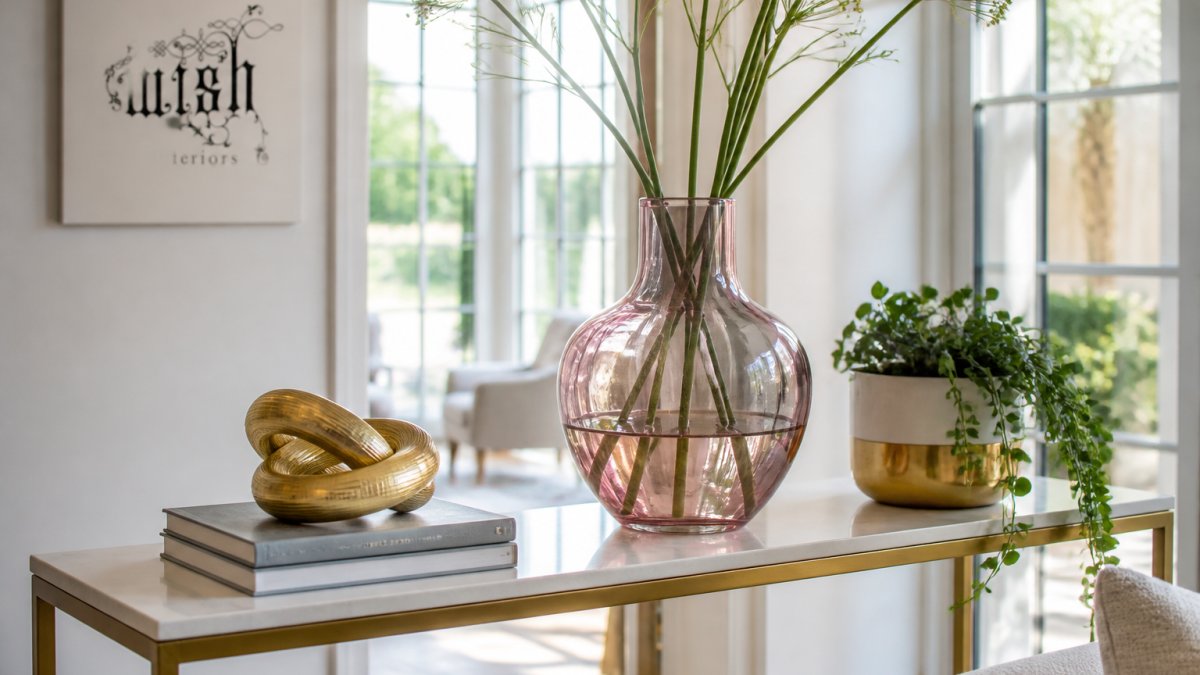
The Mirano Gold Finish Knot Sculpture suits both camps, its warm metallic finish reflecting light in a minimal scheme and adding texture in a layered one. The Bardi Large Pink Glass Vase brings colour where a room needs warmth, its corrugated surface catching daylight across the day. The Callie White and Gold Large Ceramic Planter lifts trailing plants onto a gold pedestal, so greenery reads as a feature rather than an afterthought. The Loft Abstract Cream Rug and the Astratto Natural Wall Art are the quiet constants: both neutral enough to sit under any palette.
Common Mistakes and How to Avoid Them
| Mistake | What It Looks Like | The Fix |
|---|---|---|
| Minimalism as emptiness | Bare room, no focal point | Add one oversized piece, such as a large arched mirror |
| Maximalism as clutter | Every surface covered | Lock a three-colour palette and edit to it |
| Mixed scales | Two medium patterns side by side | Pair one large pattern with small repeats |
| Accessories first | Ornaments with nothing to sit on | Choose the rug and main furniture first |
| Ignoring negative space | Furniture pushed against every wall | Leave one wall deliberately clear |
The pattern behind all five is the same: style is a decision about proportion, not a shopping list. Decide the ratio, then buy to it.
Conclusion: Choosing the Style That Fits Your Home
The honest answer is that most homes suit a dominant style with a deliberate minority influence, and the ratio matters more than the label. Minimalist if you want calm and few, excellent pieces. Maximalist if you want warmth, colour and a room that rewards a second look.
What both styles share is a demand for quality at the top end of the room. That is where Wish Interiors comes in. We build bespoke, handmade furniture for homes and commercial interiors, reupholster and restore existing pieces, and supply made-to-order curtains, roman blinds and soft furnishings, all backed by over 60 years of family-run craftsmanship and unique artist collaborations. If you are renovating, we can supply the anchor pieces first and style around them.
Call 020 46202525 to discuss your project, or browse the collection and spread the cost with Klarna.
Frequently Asked Questions
What is the difference between minimalist and maximalist interior design?
Minimalist interiors strip a room back to essential pieces, prioritising clean lines, neutral palettes and negative space. Maximalist rooms layer colour, pattern, texture and collected objects until the space feels rich and personal. Neither approach is inherently more luxurious: a minimalist luxury living room might centre on one marble coffee table, while a maximalist scheme uses many pieces working together. The deciding factor is restraint versus abundance, not budget.
Can you combine minimalist and maximalist styles in one home?
Yes, and many homes already do. The most reliable method is to pick a dominant style for the bones of the room, such as walls, flooring and large furniture, then let the other style appear in accessories. A neutral, pared-back living room with a cream abstract rug and a marble side table can carry a maximalist moment through a bold pink glass vase or a cluster of sculptures. Keep one style at roughly 70 per cent and the other at 30 per cent so the room reads as intentional.
How do you make a minimalist home feel luxurious?
Luxury in a minimalist room comes from material quality and proportion rather than quantity. Choose pieces with genuine materials such as a white marble round side table with a gold geometric base, or a large arched mirror with a slim steel frame that adds light and depth. Keep the palette tight, invest in one or two statement items, and leave generous space around them. Fewer pieces with better finishes will always look more expensive than many average ones.
How do you make maximalist decor look cohesive rather than cluttered?
Cohesion in maximalist rooms comes from a repeated thread: a colour, a metal finish, or a shape that appears throughout. If you use gold hardware, repeat it in a knot sculpture, a planter base and a mirror frame. Limit the palette to three or four core colours and let pattern do the talking within that range. Grouping accessories in odd numbers on trays or shelves also stops objects from feeling scattered, because the eye reads them as one arrangement.
Which style is easier to maintain?
Minimalist rooms are generally quicker to clean because there are fewer surfaces and objects to dust, though every piece shows marks more easily. Maximalist rooms need more regular dusting around collections, textiles and layered accessories, but they hide everyday wear better because there is more visual activity. Practical choices help either way: a fade and stain resistant rug with a 14mm high-low pile is easy to vacuum, and marble surfaces wipe clean with a soft damp cloth.
What colours work best in a maximalist living room?
Maximalist schemes handle deep, saturated colours well: emerald, plum, ink blue and burnt orange all pair naturally with metallics. The trick is to anchor them with a neutral base so the room does not become exhausting. Warm white walls, a cream rug and natural wood furniture give strong colours somewhere to sit. Add one metallic finish, gold or black, and repeat it across accessories so the palette feels deliberate rather than accidental.
What furniture works well in a luxury minimalist interior?
Look for simple silhouettes in honest materials. A round marble side table with a geometric cage base, an oval marble coffee table in Brazilian green marble, or an oversized arched mirror in gold or black all suit minimalist schemes because their shapes are clean and their finishes do the talking. Avoid ornate carving and heavy pattern. If you want one softer element, a textured cream rug adds warmth without breaking the restrained look.
How can you add maximalist touches to a minimalist room?
Start with accessories rather than furniture, because they are easy to change if the balance feels wrong. A tall pink glass vase on a console, a pair of contrasting knot sculptures in gold and black, or a cluster of framed art in one corner will add personality without disturbing the room's structure. Group items in threes, keep to one accent colour, and leave the surrounding surfaces clear so the new pieces read as a deliberate focal point.
Sample Image Gallery


