





What Does Bespoke Mean in Furniture? A 2026 Guide
Table of Contents
- Bespoke Furniture: What the Term Actually Means
- Bespoke vs Custom vs Made-to-Order vs Ready-Made
- The Bespoke Furniture Design Process, Step by Step
- The Benefits of Bespoke Furniture (and What It Costs You)
- Bespoke Sofas: What Changes When You Commission Upholstery
- Materials, Craftsmanship and Where Your Wood Comes From
- Red Flags: How to Spot a 'Bespoke' Piece That Isn't
- Caring for Bespoke Furniture So It Lasts Decades
- Frequently Asked Questions
Last Updated: September 16, 2026
Bespoke Furniture: What the Term Actually Means
What does "bespoke" mean in furniture? It means a piece designed and made specifically for one client, from the dimensions and materials to the finish, rather than adapted from an existing product line. This guide from Wish Interiors explains what the term actually covers, where it gets misused, and how to tell the difference before you commission anything.
The word carries real weight in British furniture making, and it is also one of the most overused terms in retail. A sofa described as bespoke on a showroom floor may be nothing more than a standard frame with a choice of fabric. That gap between the promise and the practice is what this article addresses.
Where the Word Comes From
Bespoke entered English through tailoring. On Savile Row, a suit was said to be "bespoken" for a particular customer, meaning the cloth was spoken for before it was cut. The garment did not exist until someone ordered it.
Furniture makers borrowed the term because the process is the same in spirit. Nothing is built until a client has committed to it. There is no stock, no warehouse of finished pieces waiting for a buyer, and no standard size that customers are quietly steered towards.
That history matters when you are assessing a quote. The word describes a relationship between maker and client, not a style or a price bracket. A modest oak shelf can be genuinely bespoke; an expensive imported sofa usually is not.
The Three Things That Make a Piece Bespoke
Three conditions separate true bespoke work from everything else.
- It is designed for you. Dimensions, proportions and detailing come from your space and your brief, not a catalogue.
- It is made to order, by hand. The piece does not exist until you commission it, and a maker builds it rather than a production line.
- You are involved in the decisions. Materials, finish and detail are agreed with you before work begins.
Remove any one of those and you have something else: made-to-measure, customised, or simply ready-made with options.
Bespoke vs Custom vs Made-to-Order vs Ready-Made
The four terms describe genuinely different processes, and retailers use them interchangeably to justify different prices. Here is the practical distinction.
| Term | Design source | Made when | Typical choices | Who leads the design |
|---|---|---|---|---|
| Bespoke | You and the maker | After commission | Dimensions, materials, finish, detailing | Shared |
| Custom | Existing design | After order | Size and surface options | Retailer |
| Made-to-order | Catalogue design | After order | Fabric or finish only | Retailer |
| Ready-made | Catalogue design | Already built | None | Retailer |
Bespoke vs Custom: The Line Most Retailers Blur
What does "bespoke" mean in furniture? The distinction comes down to who controls the design. In a bespoke commission, the maker starts with a blank page and your requirements. In a custom order, the retailer starts with a product and adjusts it.
The Bespoke Furniture Design Process, Step by Step
Most bespoke commissions follow the same path: consultation, design and quote, approval of materials, making, then delivery and fitting. The client signs off the design before any material is cut, which is what protects both sides if expectations differ later.
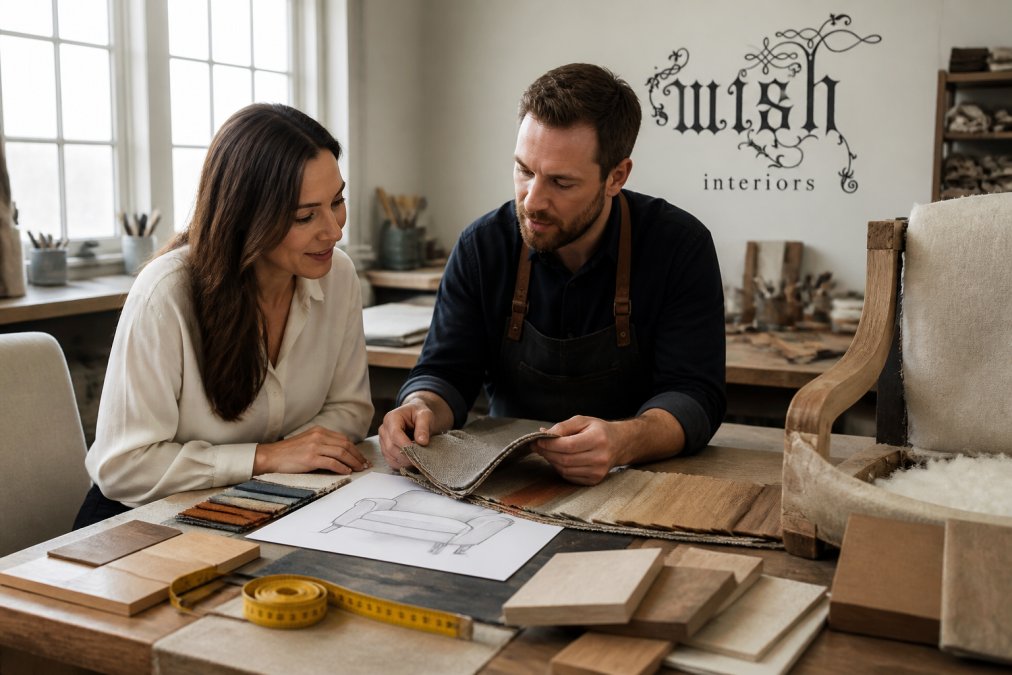
Here is how the process typically runs.
- Consultation. You discuss the room, how the piece will be used, and any constraints such as low ceilings or awkward corners.
- Design and quotation. The maker produces a drawing or specification and prices it against your brief.
- Material selection. You review wood samples, fabrics and finishes, and agree the final combination in writing.
- Approval. You sign off dimensions, materials and finish before work starts.
- Making. The piece is built by hand, usually with progress updates on longer projects.
- Delivery and fitting. The finished piece is installed and checked against the agreed specification.
Your Role in the Design Phase
Clients often assume they need finished drawings before approaching a maker. They do not. What a maker needs is information about the space and how you live in it.
Useful things to bring to a first consultation:
Bespoke Work From Home Desk & Stool →
- Rough room dimensions, including ceiling height and any sloped surfaces
- Photographs of the space from a few angles
- Notes on how the piece will be used, such as seating numbers or storage needs
- Any fabrics, paint colours or existing pieces it must sit alongside
The Benefits of Bespoke Furniture (and What It Costs You)
The main benefit of bespoke furniture is fit: a piece made for your room uses space that standard furniture wastes. The trade-off is time and money. A bespoke commission takes longer and costs more than a comparable ready-made piece, because you are paying for design hours and handwork rather than volume production.
What you gain in return:
- Furniture that fits the room exactly, including alcoves, bays and irregular walls
- Materials and finishes chosen by you, not limited to a catalogue
- A piece that can be repaired and reupholstered rather than replaced
- Something that will not appear in a neighbour's front room
Fitting Awkward Spaces and Low Ceilings
Awkward rooms are where bespoke earns its place. An L-shaped living room with a low ceiling defeats most standard sofas, which are built to a fixed height and depth that assumes a rectangular space.
Bespoke Sofas: What Changes When You Commission Upholstery
A bespoke sofa differs from a standard one in four places: frame dimensions, seat depth and height, cushion fill, and upholstery. Every one of those is agreed with you before the frame is built, which is why the finished piece behaves differently in a room than a showroom model would.
Materials, Craftsmanship and Where Your Wood Comes From
Material sourcing is the question most buyers forget to ask, and it is the one that separates a piece built to last from one built to a price. Ask which species of wood is used, where it was grown, and how it was dried.
Red Flags: How to Spot a 'Bespoke' Piece That Isn't
A piece marketed as bespoke is not bespoke if the design already existed before you enquired. That single test catches most misuse of the term, and it takes one question to apply.
Other warning signs worth noting:
- A price quoted before anyone asks about your room. Genuine bespoke pricing depends on dimensions and materials.
- No drawing or written specification. If nothing is agreed in writing, nothing is protected.
- A lead time that seems impossibly short. Handmaking takes time.
- No samples for materials. You should see and handle the actual finish.
- No information about the frame. Ask what it is made from and how it is jointed.
- Reluctance to discuss aftercare. A maker who expects the piece to last will talk about maintaining it.
Caring for Bespoke Furniture So It Lasts Decades
For anyone weighing up a commission, the practical starting point is a conversation about the room rather than a browse through a catalogue. Wish Interiors has spent over 60 years making handmade furniture for homes and commercial spaces, from bespoke desks and storage through to fitted shelving, with Klarna available to spread the cost. Call 020 46202525 to discuss a commission, or browse the range to see how bespoke sizing and finish options work in practice.
Frequently Asked Questions
Is bespoke furniture better quality than mass-produced items?
Not automatically, but the odds are better. Bespoke furniture is built one piece at a time by a named maker, so joints, frames and upholstery get individual attention that a production line cannot give. The quality still depends on the workshop. Ask what the frame is made from, how the joints are cut and whether the maker offers a care kit or aftercare advice. A bespoke commission from an experienced upholsterer will usually outlast a mass-produced equivalent, and it can be repaired rather than replaced.
What is the difference between custom-made and bespoke furniture?
Custom-made means you choose from a set of options the maker already offers: pick a fabric, pick a leg style, adjust the length within a range. Bespoke means the piece is designed around your space and your brief from the start, including dimensions, materials and finish. In practice, many retailers use the two terms interchangeably. The honest test is simple: if the workshop can only build what is already on its price list, it is custom, not bespoke.
Are bespoke sofas worth the higher price point?
They are worth it when a standard sofa cannot do the job. Awkward room shapes, low ceilings, a specific fabric you cannot find elsewhere, or a commercial space that needs 40 identical chairs all push you towards bespoke sofas. You are paying for fit, materials and the maker's time rather than a brand name. If a ready-made sofa already fits your room and your taste, the extra spend buys you little. If nothing standard fits, bespoke is often the cheaper long-term answer.
How long does the process of commissioning bespoke furniture take?
A single piece such as a desk, blanket box or shelf typically takes a few weeks from approved design to delivery, because the woodwork is handmade to order. Larger commissions, such as a full upholstered sofa or a batch of hotel room furniture, run longer. Lead time depends on fabric availability, the number of pieces and how quickly you sign off samples. Ask for a written timeline before you pay a deposit, and agree what happens if a fabric is discontinued mid-project.
Sample Image Gallery


