





How Much to Re-Upholster a Sofa? 2026 Cost Guide
Table of Contents
- What Drives the Cost of Sofa Re-Upholstery?
- Re-Upholstery vs Buying New: Which Makes Sense?
- How Long Does Sofa Re-Upholstery Take?
- Best Fabrics for Sofa Re-Upholstery
- Traditional vs Modern Upholstery Techniques
- How to Save Money on Sofa Re-Upholstery
- Frequently Asked Questions
Last Updated: September 10, 2026
What Drives the Cost of Sofa Re-Upholstery?
Anyone asking how much to re-upholster a sofa? is really asking what they can control. The honest answer is that the price is built from three moving parts: the fabric you choose, the hours of hand-work your frame demands, and the condition of what sits underneath the old cover. Two sofas of identical size can land at wildly different figures because one needs a fresh skin and the other needs a rebuild.
Fabric: The Biggest Variable
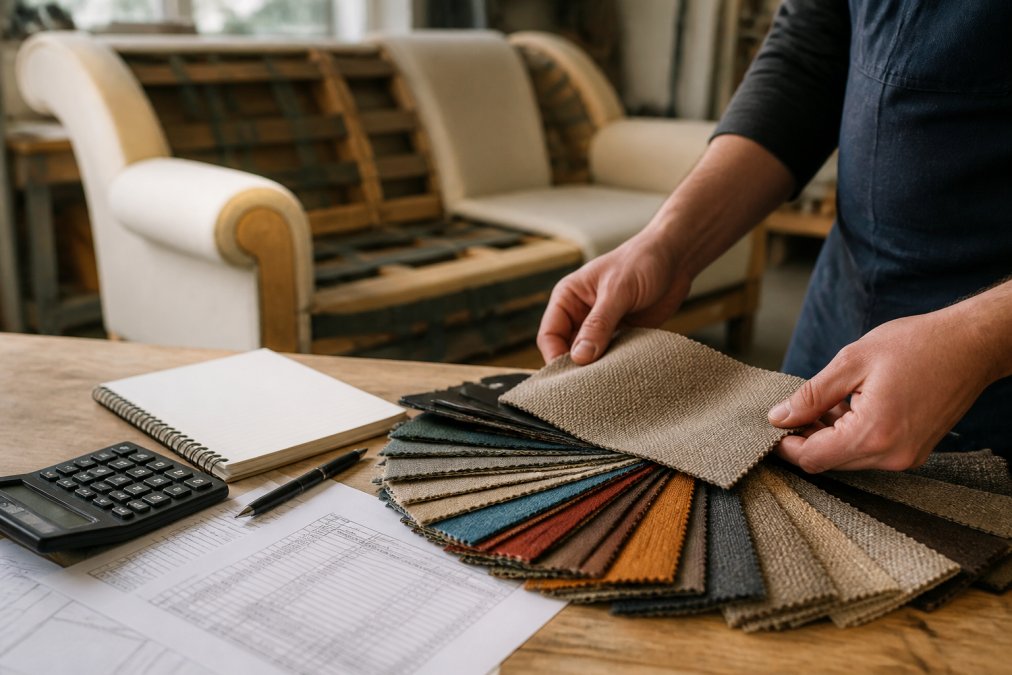
Fabric is the single largest line on most quotes, and it is where you have the most use. Cloth is priced by the metre, and a sofa swallows a surprising amount of it once you allow for pattern matching and wastage. A plain weave on a two-seater needs far fewer metres than a large-check design on a three-seater, because every check has to line up across the back, arms and cushions.
Fabric grade matters as much as quantity. Entry-level weaves sit at the bottom of the scale, mid-range linens and velvets sit in the middle, and high-performance or designer cloths climb from there. Leather is quoted differently again, by hide rather than metre, and you need more than one hide for most sofas.
Labour: Why Hand-Stitched Work Costs More
Labour is charged in hours, and hours are where traditional and modern workshops diverge. A machine-led rebuild moves quickly. A hand-stitched piece, with individually set springs, hand-tied coils and hand-sewn piping, can take several times longer for the same footprint. That difference is not padding: it is the reason a well-built sofa holds its shape for decades rather than years.
The condition of the frame decides how much of that labour is fabric work and how much is structural. A sound hardwood frame needs stripping, re-padding and recovering. A frame with failed joints or tired springs needs repair before a single metre of new cloth goes on.
Re-Upholstery vs Buying New: Which Makes Sense?
Re-upholstery usually wins when the frame is solid and the piece is worth keeping. Buying new wins when the frame is failing, the shape no longer suits the room, or the cost of a rebuild approaches the cost of a replacement of similar quality. The decision hinges on how much to re-upholster a sofa? against what you already own, not on the age of the cover.
The mistake most homeowners make is comparing the re-upholstery quote against the price of a cheap new sofa. That is not a like-for-like comparison. A rebuild restores a hardwood frame, hand-tied springs and solid joinery that a budget replacement simply does not contain. Compare the quote against the cost of a new sofa of the same build quality, and the maths changes completely.
Assess the Frame Before You Assess the Fabric
The single most useful thing you can do is separate fabric work from structural work. They are priced very differently, and only one of them is optional.
- Fabric-only recover. The frame is sound, joints are tight, springs are intact. You are paying for stripping, re-padding and new cloth. This is the cheapest realistic outcome.
- Fabric plus padding. The frame is sound but the seat cushions and back have collapsed. New high-resilience foam or a re-webbed base is added. Moderate cost.
- Fabric plus spring work. Springs are broken, sagging or noisy. The spring unit is rebuilt or replaced before recovering. This is where quotes climb sharply.
- Full frame restoration. Failed joints, cracked rails or a warped frame. The piece is stripped to the bare frame, joints are re-glued and re-blocked, and the whole foundation is rebuilt. This is the most expensive route and only makes sense on a genuinely well-made or antique piece.
A useful test: press down hard on the seat and listen. Creaking, knocking or a soft, bottoming-out feel points to spring or frame trouble. Rock the sofa gently from the arm. Any movement between the frame members means joint repair is coming, whether the quote mentions it yet or not.
The Cost-Ratio Rule
If a full rebuild is quoted at more than about half the price of a new sofa of equivalent quality, buying new deserves serious consideration. Below that threshold, and assuming the frame passes the assessment above, re-upholstery is normally the better long-term spend because you are keeping the most durable part of the sofa and replacing only the part that wears out.
Run this comparison before you commit:
| Situation | Better Option | Why |
|---|---|---|
| Solid hardwood frame, worn fabric only | Re-upholster | Frame outlasts several covers |
| Sound frame, collapsed cushions | Re-upholster with new padding | Cheaper than a rebuild |
| Failed joints or broken springs | Get a structural quote first | Repair cost decides the outcome |
| Sentimental or antique piece | Re-upholster | Replacement cannot match it |
| Shape no longer fits the room | Buy new | A rebuild cannot change dimensions |
| Budget sofa, minor wear | Buy new | Rebuild rarely pays back on a cheap frame |
What You Are Really Paying For
When you re-upholster, you keep the frame, the springs (if sound) and the shape. You replace the fabric, the padding and any failed components. When you buy new, you replace everything, including the frame you already own and which may well be better than anything you can buy at the same price today. That is the whole argument in one sentence, and it is why the condition of the frame, not the condition of the cover, should drive your decision. professional upholstery cleaning.
How Long Does Sofa Re-Upholstery Take?
A straightforward recover on a two-seater typically takes one to two weeks in a workshop. A full rebuild with frame repair, new springs and hand-finished detailing can run to four weeks or longer, depending on fabric lead times and how busy the workshop is.
Several things stretch that timeline:
- Fabric ordered from a mill, which can add days or weeks
- Pattern matching on large repeats, which slows every panel
- Frame repair or spring replacement discovered after stripping
- Piping, frills and detailing sewn by hand
- Delivery and collection scheduling
A common mistake is booking the upholsterer before the fabric arrives. Order cloth first, confirm the delivery date, then book the slot.
Best Fabrics for Sofa Re-Upholstery
The best fabric for a sofa is the one that matches how the room is actually used, not the one that looks best in a sample book. Durability is measured by rub count, which tells you how many abrasions a cloth withstands before showing wear. As a working guide, most domestic upholstery fabrics fall into three bands: light domestic use around 10,000 to 15,000 rubs, general domestic use around 20,000 to 25,000 rubs, and heavy domestic or contract-grade cloth at 30,000 rubs and above (bsi.com). A family living room with pets and children belongs in the top band. A formal sitting room that sees occasional use can take something finer.
Matching Fabric to the Room
| Fabric | Rub count band | Best for | Watch out for |
|---|---|---|---|
| Wool and wool blends | 20,000-40,000 | Family rooms, high traffic | Higher cost per metre |
| Tight-weave linen | 15,000-25,000 | Formal rooms, breathable comfort | Creases, can be less stain-resistant |
| Cotton and cotton blends | 10,000-20,000 | Budget-conscious recoveries | Fades in direct sunlight |
| Velvet (including performance velvet) | 20,000-50,000 | Statement pieces, depth of colour | Shows crushing and shading on seats |
| Performance weaves (easy-clean) | 30,000-50,000 | Pets, children, spill-prone rooms | Can feel less natural to the touch |
| Leather | Measured differently (by hide) | Everyday knocks, longevity | Higher upfront cost, needs more hides |
Wool and wool blends resist pilling and hold colour well. Tight-weave linens are breathable and age gracefully. Velvet gives depth and luxury but shows crushing in heavy-use seats. Performance weaves handle spills and pets. Leather is the most forgiving of everyday knocks and simply improves with age, but it is quoted by the hide rather than the metre, and most sofas need more than one hide once you allow for pattern matching and wastage.
Pattern, Repeat and Wastage
Pattern repeat is the hidden cost in fabric selection. A plain weave wastes very little because every panel can be cut from any part of the roll. A large-check or floral design with a 60cm repeat forces the upholsterer to align the pattern across the back, arms and cushions, which means buying extra metres to allow for matching. The bigger the repeat, the more fabric you pay for and the more labour the job takes. If you are working to a budget, a plain or small-repeat cloth is the single easiest way to reduce the fabric line on the quote.
Fire Safety and Compliance
Fire safety regulations apply to domestic upholstered furniture sold in the UK, and any fabric used must meet the relevant flammability requirements (gov.uk). UK government guidance on fire safety of domestic upholstered furniture sets out what compliant filling and covering materials must do. When you supply your own fabric, check that it carries the correct compliance documentation before it reaches the workshop, because an upholsterer cannot legally use non-compliant cloth on domestic furniture.
Never buy upholstery fabric on appearance alone. A cloth with a low rub count can look superb on day one and show bald patches within a year in a family living room. Ask for the rub count in writing before you commit, and check the fire safety documentation at the same time.
Traditional vs Modern Upholstery Techniques
Traditional and modern techniques produce different sofas, not better and worse ones. Traditional work means hand-tied springs, horsehair or coir padding, hand-stitched seams and hand-sewn piping. It is labour-intensive, slower, and produces a seat with a distinctive spring and a long service life.
Modern techniques use foam padding, machine-sewn seams, webbing or serpentine springs and staple-fixed covers. It is faster and more affordable, and for many homes it is perfectly adequate. Where it falls short is in longevity: foam compresses, webbing sags, and staples work loose sooner than a hand-tied foundation.
What most guides miss is that the two are not mutually exclusive. A sensible rebuild often uses a hand-tied spring unit with modern high-resilience foam on top, which gives you the comfort of traditional construction with the practicality of modern materials.
How to Save Money on Sofa Re-Upholstery
The biggest saving comes from doing the preparation yourself. Stripping the old cover, removing staples and labelling the panels before the piece reaches the workshop can cut hours of labour from the bill. So does choosing a fabric with no pattern repeat, since plain cloth wastes far less.
Other routes to a lower figure:
- Reuse the existing cushions and replace only the covers
- Repair the frame rather than replacing the whole piece
- Choose a mid-grade fabric with a high rub count instead of a designer cloth
- Supply your own fabric, if your upholsterer is happy to work with customer cloth
One caution on the last point: if you supply faulty or short fabric, the workshop cannot be responsible for the result, and a shortage mid-job can delay everything.
The cheapest re-upholstery quote is rarely the best value. A low price can mean a lower-grade fabric, machine-only construction, or skipped frame repair. Ask what is included before comparing figures.
Re-upholstering a sofa is a considered spend, and the gap between a good rebuild and a poor one shows up within a couple of years. Wish Interiors has been making bespoke, handmade furniture for over 60 years, with every piece built to order in our own workshop and finished by hand. We offer custom upholstery, printed sofas and limited-edition chairs for homes and commercial interiors, and you can spread the cost with Klarna. Call 020 46202525 to discuss your sofa and get a quote built around your frame, your fabric and your room.
Frequently Asked Questions
Is it worth re-upholstering a sofa?
It depends on the frame's condition. If the frame is solid and the sofa is well-made, re-upholstery costs less than a comparable new piece and extends furniture longevity by decades. For cheaper sofas with weak frames, buying new often makes more sense. A professional upholsterer can appraise your sofa and give an honest recommendation before you commit.
Can I get my sofa restuffed instead of fully re-upholstered?
Yes, if the fabric is still in good condition. Restuffing replaces foam padding and cushion filling without changing the cover. It costs less than full re-upholstery and takes less time. However, if the fabric is worn or torn, a full re-upholstery is the better long-term fix. Ask your upholsterer to assess both the fabric and the internal fillings.
What factors affect the price of furniture re-upholstery?
The main factors are fabric choice, labour hours, sofa size, and frame condition. Fabric is priced per metre and ranges from basic weaves to designer prints. Labour costs depend on the complexity of the design, such as piping and detailing. A two-seater sofa needs less fabric than a three-seater. If the frame needs spring replacement or repairs, that adds to the cost.
How long does the re-upholstery process take?
Most sofa re-upholstery projects take two to six weeks. Simpler designs with standard fabrics can be completed in two to three weeks. Complex pieces with bespoke covers, piping, or special detailing may take longer. If the frame needs repair or spring replacement, add extra time. Always confirm the timeline with your upholsterer before booking.
Sample Image Gallery


