





Is Hiring an Interior Designer Worth It for Renovations?
Table of Contents
- The Real Question: What Does an Interior Designer Actually Do?
- Interior Designer Cost UK: What You'll Pay in 2026
- The Benefits of Hiring an Interior Designer for Renovations
- DIY vs Professional Renovation Management: A Side-by-Side Comparison
- Bespoke Furniture for Home Renovations: Where Designers Add Tangible Value
- When Is Hiring an Interior Designer Worth It? A Decision Framework
- Conclusion
- Frequently Asked Questions
Last Updated: September 11, 2026
The Real Question: What Does an Interior Designer Actually Do?
An interior designer plans, specifies and project-manages the look, layout and finish of a space, from concept drawings to the final cushion. Whether hiring an interior designer is worth it for renovations comes down to how much you can genuinely do yourself, and how much a mistake would cost you.
At Wish Interiors, we've spent over 60 years making bespoke furniture for homes and commercial interiors, so we see both sides: designers specifying pieces that fit a room perfectly, and homeowners discovering the wrong size sofa three weeks into a build.
Below, we break down what designers do, what they cost, and where the money goes.
Scope of Work: From Floor Plans to Final Styling
A designer's job starts with space planning: measuring the room, mapping traffic flow, and producing floor plans showing where furniture, lighting and storage will sit (asid.org). Then comes material selection, furniture sourcing, procurement, and often construction oversight.
The scope typically runs in this order:
- Concept and mood boards
- Measured floor plans and architectural drawings
- Material and finish specification
- Furniture and lighting sourcing
- Contractor coordination and site visits
- Final styling and snagging
Where Designers Stop and Contractors Begin
Designers specify and coordinate; contractors build. A designer draws where the wall should move; a builder knocks it down and checks whether it's load-bearing.
This matters because the Designer-Contractor conflict is the most common source of renovation stress: when the person drawing the plans and the person building them aren't talking, you become the messenger. Most designers charge separately for construction oversight, so confirm whether site visits are included before you sign.
Interior Designer Cost UK: What You'll Pay in 2026
Interior design services are billed hourly, as a fixed fee, or as a percentage of the overall project. The model tells you where a designer's incentives sit.
Hourly Rates, Fixed Fees and Percentage-of-Project Pricing
The percentage-of-project fee is most common for full renovations, charged as a slice of total build and furnishing spend (asid.org). It scales with your budget, so a larger project pays more even when the work is similar.
Hourly rates suit smaller consultations, and a design retainer works for ongoing input without handing over the whole project. Fixed fees give cost certainty, but designers build in a buffer for scope creep.
| Pricing Model | Best For | Main Risk |
|---|---|---|
| Hourly rate | Single-room advice, quick consultations | Costs climb if the project drags |
| Fixed fee | Clearly defined scope, one or two rooms | Change requests billed separately |
| Percentage of project | Full renovations with large budgets | Fee rises as your spend rises |
| Design retainer | Ongoing input across a phased project | Less clarity on total cost upfront |
How the Percentage Fee Lands on a Real Budget
The percentage model is hardest to sanity-check because the fee moves with the build. A common pattern is tiered: a higher percentage on smaller projects, lower as spend grows, since design input doesn't scale linearly with build cost.
Work through it on a mid-range kitchen and dining knock-through:
- Build and joinery spend: £45,000
- Furniture, lighting and finishes: £15,000
- Total project spend: £60,000
- Design fee at a mid-tier percentage: £6,000-£9,000
Now the same designer on a single-room refresh:
- Total project spend: £12,000
- Design fee at a higher small-project percentage: £1,800-£2,400
Two things follow. The fee is a fixed proportion of a number you control, so trimming the specification trims the fee. And on small projects the percentage is often steep enough that a fixed fee or hourly consultation is better value. Ask any designer quoting a percentage what happens if the build cost rises mid-project, the answer should be in the contract.
How Trade Discounts and Procurement Affect Your Final Bill
Trade discounts are where the maths gets interesting. Designers hold trade accounts that can reduce the cost of furniture, fabric and fittings. Some pass the full discount to you and charge a procurement fee on top; others keep the difference and charge you retail.
Ask which model applies. A designer who passes discounts through with a transparent fee is usually cheaper than one offering a low headline rate while marking up every item.
Run the comparison on a single purchase. A sofa with a retail price of £2,000 might carry a trade price of £1,400, a 30% discount (gov.uk). Under a pass-through model you pay £1,400 plus, say, a 15% procurement fee (£210), so £1,610. Under a keep-the-difference model you pay the full £2,000 and the designer banks £600. Same sofa, £390 difference, and it compounds across every item in the schedule.
What the Fee Actually Buys You
Strip the pricing models back and the fee pays for three things: drawings and specification, procurement and coordination, and risk reduction. The first two are visible; the third justifies the cost on a complex job, because a single avoided rework, a kitchen re-plumbed, a floor taken up, can exceed the entire design fee.
Compare quotes on those three lines, not the headline rate. A cheap hourly quote excluding site visits and procurement isn't the same product as a percentage fee that includes both.
The Benefits of Hiring an Interior Designer for Renovations
The benefits of hiring an interior designer for renovations fall into two buckets: money saved through better decisions, and money saved through mistakes avoided. The second is bigger than most homeowners expect.
Space Planning, Budget Management and Avoiding Costly Mistakes
Good spatial awareness prevents the costliest errors: a kitchen island blocking the walkway, a door that can't open past a radiator, a sofa that won't fit up the stairwell. These aren't aesthetic problems, they're rework, the most expensive line in any renovation.
Budget management is the quieter benefit: a designer allocates spend across structure, services, finishes and furniture before work starts, so you're not choosing between a boiler and a bathroom in month three. Treating the design fee as an extra cost is a mistake, it's a control on your largest project cost. investing in designer furniture.
The Psychological ROI: Why Good Design Feels Worth More Than It Costs
Here's what most cost breakdowns miss: a room that works changes how you use your home, and that has a value no spreadsheet captures.
A well-planned kitchen becomes the room everyone gathers in; a properly lit living room gets used in the evening instead of abandoned for the bedroom television. Many homeowners describe the result not as a return on investment but as a daily improvement they'd struggle to put a number on.
That's the psychological ROI, and it's real. It just doesn't appear on a cost-benefit analysis.
DIY vs Professional Renovation Management: A Side-by-Side Comparison
DIY renovation management is viable when the scope is simple, the trades reliable, and you have time to coordinate them. Professional management wins with multiple trades, structural work, or a fixed deadline.
The honest comparison isn't skill versus no skill. It's time versus money.
| Factor | DIY Management | Professional Designer |
|---|---|---|
| Upfront cost | Lower | Design fee applies |
| Your time commitment | High, often weekly site visits | Low, designer coordinates |
| Trade coordination | You chase every tradesperson | Designer manages the schedule |
| Mistake risk | Higher on layout and specification | Lower, plans are tested first |
| Material sourcing | Retail prices | Trade discounts and procurement |
| Best suited to | Single rooms, cosmetic work | Multi-room, structural, tight deadlines |
If you work full time and the project touches more than one room, DIY usually costs you annual leave and evenings rather than cash, a real cost, even when it doesn't show on an invoice.
Bespoke Furniture for Home Renovations: Where Designers Add Tangible Value
Bespoke furniture for home renovations is where a designer's input shows most visibly, because awkward spaces are the norm: low ceilings, chimney breasts, L-shaped living rooms and narrow Victorian hallways all defeat standard-sized furniture.
That's the practical case for going custom: a made-to-measure piece fills the gap a stock item leaves, built for the room rather than adjusted to it.
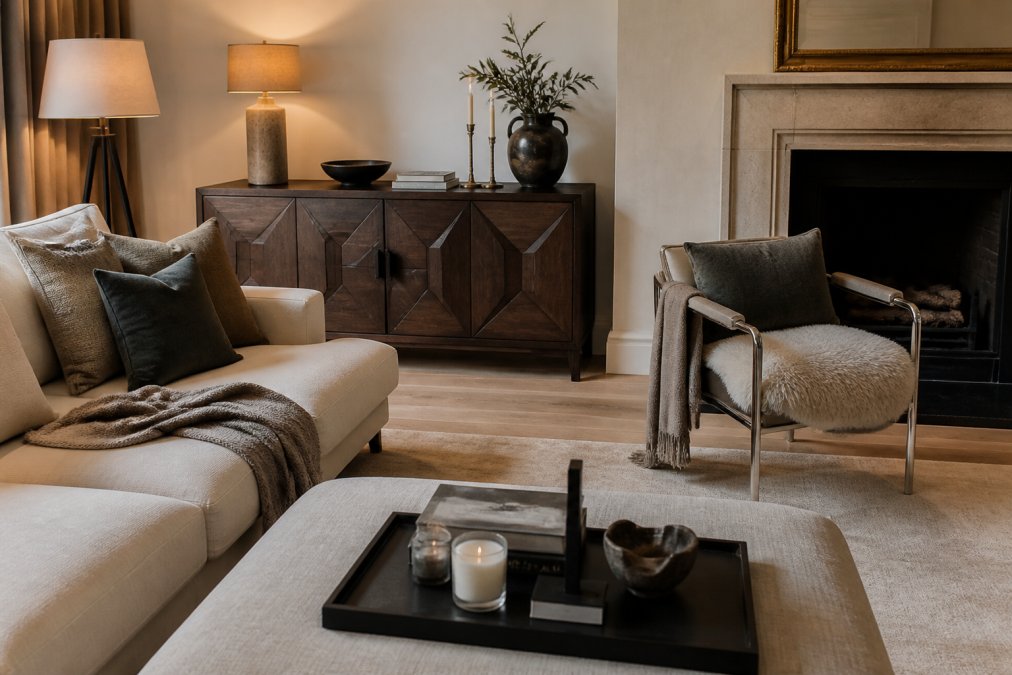
A few examples from our own workshop show what this looks like in practice:
- The Toulouse Cream Fabric Armless Modular Sofa (£593.99) slots between other sections to build a sectional that fits an exact wall length, which is useful in open-plan spaces where a fixed sofa leaves dead corners.
- The Lucca Recycled Dark Oak Wood Sideboard (£1,187.99) runs to 200cm wide, sized for a dining room wall rather than squeezed into it.
- The Novara Silver Baroque Chair (£329.99) works as a single accent piece in a hallway or dressing room where nothing standard sits correctly.
The trade-off is lead time. Bespoke pieces take longer than a next-day delivery, so order before the build finishes, not after.

When Is Hiring an Interior Designer Worth It? A Decision Framework
Hiring an interior designer is worth it when the project involves multiple rooms, structural change, or a fixed deadline, and not worth it for single-room cosmetic updates you can plan yourself. Use the framework below.
Step 1: Count the trades. One trade, one room, no structural work? Manage it yourself. Three or more trades on a schedule? Bring in a designer.
Step 2: Assess layout complexity. If the room works as it is and you're only changing finishes, DIY is fine. If walls are moving or the layout defeats you, you need floor plans.
Step 3: Price your time. Estimate the hours you'll spend on sourcing, chasing and site visits. Multiply by what your time is worth. Compare that to the design fee.
Step 4: Check the budget. If a single wrong specification would blow your contingency, professional input is insurance, not luxury.
The Complexity Score: A Quick Self-Assessment
"Multi-room" and "structural" are vague, and homeowners tend to under-rate their own project's complexity. Score your renovation against the six factors below, one point each.
| Factor | Score 1 if... |
|---|---|
| Rooms affected | More than one room is being changed |
| Structural work | Any wall, floor or opening is being altered |
| Trades involved | Three or more separate trades are needed |
| Services | Plumbing, electrics or heating are being moved |
| Fixed deadline | You have a date you cannot move (sale, rental, return to work) |
| Specification risk | A single wrong choice would cost more than the design fee |
How to read your score:
- 0-1: DIY management is realistic. A designer adds polish, not protection.
- 2-3: Borderline. A fixed-fee consultation or a single-room design package is usually the right spend.
- 4-6: Professional design and project management is very likely to pay for itself in avoided rework and time saved.
This is the assessment most homeowners never run, which is why so many overpay for a simple refresh or under-invest in a complex build. The score isn't a verdict, it's a starting point when you request quotes.
Small-Scale Renovation Feasibility: When You Can Go It Alone
Small-scale renovations are usually fine without a designer: a bathroom refresh, a repaint, new flooring, or swapping furniture in a room that already works need no professional plans.
It tips over when a "small" job turns structural. Removing a wall, moving a soil pipe, or reconfiguring a kitchen changes the trade count and the risk, at which point the design fee is a small fraction of what a mistake costs.
Red Flags in Designer Contracts and How to Spot Them
Watch for these before you sign:
- No written scope of work, or a scope that lists deliverables vaguely
- Procurement terms that don't state whether trade discounts pass to you
- No mention of site visit frequency or construction oversight
- Payment schedules front-loaded before any drawings are issued
- No professional indemnity insurance details provided
- Cancellation terms that are unclear or one-sided
If a designer won't put procurement and site visits in writing, that's your answer.
Conclusion
Interior design isn't worth it for every renovation. The homeowners who get the most from it matched the fee to the job's complexity: where the project is multi-room, structural or deadline-driven, professional input pays for itself in avoided rework and better use of space.
Frequently Asked Questions
How much does an interior designer typically charge for a renovation?
Interior designer cost UK varies by scope and pricing model. Hourly rates range from £50 to £150, while a percentage-of-project fee typically sits between 10% and 15% of the total renovation budget. Some designers charge a fixed fee per room or a design retainer. For a full-home renovation, expect to pay more than for a single-room refresh. Always ask for a written breakdown before committing, and check whether procurement and contractor coordination are included or billed separately.
Does hiring an interior designer actually save money on materials?
Designers often access trade discounts of 10% to 20% on furniture, fabrics and finishes that are not available to the public. On a renovation with significant procurement, these savings can offset a portion of the design fee. The bigger financial benefit comes from avoiding expensive mistakes: wrong measurements, poor space planning, or ordering pieces that do not fit. A designer's expertise in material selection and cost-benefit analysis frequently prevents costly rework.
What are the red flags when hiring an interior designer?
Watch for contracts that lack a clear project scope, vague fee structures, or no mention of design insurance. A designer who pressures you to sign immediately, cannot show a portfolio of completed renovations, or refuses to put timelines in writing is a risk. Also be cautious if they demand large upfront payments without staged milestones. Reputable designers provide a written scope of work, a renovation timeline, and transparent terms for changes or cancellations.
Should I hire a designer for a small renovation or can I manage it myself?
Small-scale renovations such as a single-room refresh, painting, or swapping furniture often do not require a designer. If your project involves structural changes, multiple tradespeople, or a significant budget, professional help reduces stress and prevents errors. Ask yourself whether you have the time for contractor coordination, the confidence in space planning, and the knowledge to source materials at competitive prices. If any answer is no, a design consultation may be a worthwhile investment.
What is the difference between an interior designer and an interior decorator?
An interior designer handles architectural drawings, floor plans, space planning, and construction oversight, and may coordinate with contractors on structural changes. An interior decorator focuses on finishes, furniture sourcing, and design aesthetic without managing building work. For a renovation involving walls, plumbing, or electrical changes, you need a designer. For a cosmetic refresh with new furniture and accessories, a decorator or your own eye may be enough.
If your renovation needs furniture that fits the room rather than the other way around, Wish Interiors has spent over 60 years making bespoke, handmade pieces for homes and commercial interiors. We offer custom upholstery, artist collaborations and made-to-measure furniture, with Klarna available to spread the cost. Get started with Wish Interiors and furnish your renovation with pieces built for the space. Call 020 46202525.
Sample Image Gallery


