





How Long for Custom Furniture Delivery? Lead Times
Table of Contents
- Custom Furniture Delivery: What Is a Realistic Lead Time?
- Bespoke Furniture Lead Times: Benchmarks by Piece Type
- Factors Affecting Custom Furniture Delivery
- What to Expect During the Bespoke Furniture Process
- Tracking Your Order and Handling Delays
- How to Prepare for Your Delivery Day
- Conclusion: Plan Your Project Around a Realistic Timeline
- Frequently Asked Questions
Last Updated: September 6, 2026
Custom Furniture Delivery: What Is a Realistic Lead Time?
Custom furniture delivery typically takes between 6 and 12 weeks from order confirmation, depending on the complexity of the build and the materials involved. That range reflects the reality of a piece constructed from scratch rather than pulled from a warehouse shelf.
Bespoke furniture is not manufactured until you place your order. There is no supply chain buffer holding your sofa or dining table in a distribution centre. The production schedule starts when your specification is locked in, so the clock only begins ticking after you approve the design, fabric, and dimensions.

Below, we break down realistic lead times by piece type, explain the factors that stretch or shorten the timeline, and give you a practical checklist for preparation. Custom furniture delivery varies more by the finishing process than by the size of the piece.
Bespoke Furniture Lead Times: Benchmarks by Piece Type
Most workshops quote bespoke furniture lead times in working days, not calendar weeks, because weekends and bank holidays pause the production schedule. A realistic benchmark for a hand-built dining table is 8 to 10 weeks, while a fully upholstered sofa with tailored piping typically requires 10 to 12 weeks to allow for frame construction, webbing, and multiple fitting stages.
| Piece Type | Typical Lead Time | Main Time Drivers |
|---|---|---|
| Dining table with steel legs | 6-8 weeks | Timber seasoning, metal fabrication, finishing |
| Upholstered sofa or armchair | 10-12 weeks | Frame build, webbing, multiple upholstery fittings |
| Headboard (upholstered) | 6-8 weeks | Foam cutting, fabric matching, piping detail |
| Kitchen island or breakfast bar | 8-10 weeks | Bespoke sizing, storage joinery, finish coats |
Upholstered Pieces vs. Tables and Cabinetry
Upholstered pieces take longer because they involve more skilled hand labour and sequential stages that cannot be rushed. An upholsterer must build the frame, apply webbing, fit the first layer of padding, then return after the foam has settled to add the final cover.

Tables and cabinetry, by contrast, depend more on the finish than the joinery. A clear lacquer or natural oil finish dries quickly, but a painted or stained surface requires multiple coats with sanding between each one. That is why two apparently similar tables can have very different dispatch dates.
Factors Affecting Custom Furniture Delivery
The most significant factor affecting custom furniture delivery is the workshop's current production schedule, which shifts with seasonal demand, followed by the complexity of your specification and the availability of your chosen materials.
- Fabric and material sourcing: If your chosen upholstery fabric is a special order or an artist collaboration print, the workshop must wait for the roll to arrive before cutting can begin. Stock fabrics start production immediately.
- Bespoke sizing: Non-standard dimensions require more planning time and often mean the frame must be built entirely by hand rather than from pre-cut components.
- Finish selection: As noted, painted and stained finishes add curing days between coats, while oiled finishes move faster.
- Quality control: Hand-crafted pieces are inspected at multiple stages, and any imperfection sends the piece back a step rather than forward to dispatch.
Curing Time and Finishing Processes
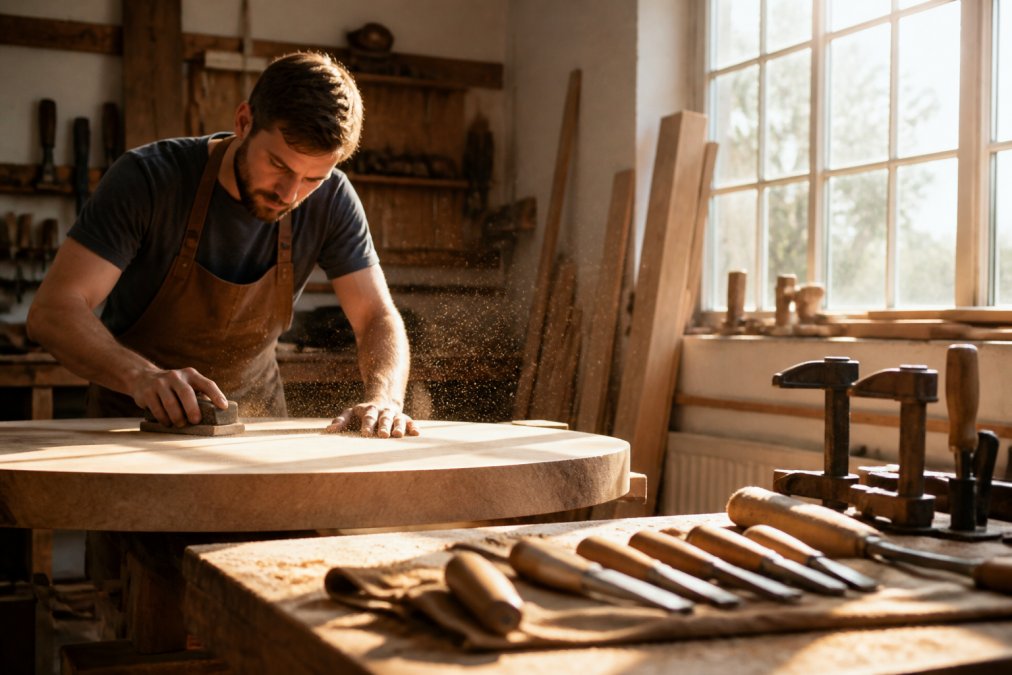
The single most misunderstood stage is curing time. A painted table may look dry within hours, but the finish needs days to harden fully before it can be wrapped, transported, and handled without marking.
The finishing process on a bespoke piece is not a single coat applied at the end; it is a sequence of preparation, priming, painting, sanding, and sealing that can span a week of the production schedule. Expect this stage to add several working days to the overall timeline, and treat any maker who promises to compress it with suspicion.
What to Expect During the Bespoke Furniture Process
The bespoke furniture process follows a predictable arc. Here is the stage-by-stage reality, including the curing and finishing process that quietly consumes two to four weeks of your lead time.
Stage 1: Order Processing and Material Quarantine (Days 1-5)
After you place your order, the workshop does not immediately start cutting timber. Your specification is checked against the production schedule, and materials are pulled from stock or ordered. Hardwood is typically stored in a climate-controlled area to stabilise its moisture content at around 8-12%; if timber arrives with higher moisture, it must acclimatise for several days before machining, otherwise the finished piece will warp or crack.
You will receive an order confirmation, but do not expect a fixed dispatch date yet. Reputable workshops quote an estimated arrival window, usually a two-week spread, because the next stages have natural variability.
Stage 2: Cutting, Joinery, and Frame Construction (Weeks 2-4)
This is the visible 'making' stage. For a dining table, the top is glued up from multiple boards, then the frame or legs are cut and jointed. For upholstered pieces, the hardwood frame is assembled, webbed, and braced. A common pattern is to build the piece, then leave it clamped for 24-48 hours so the adhesive reaches full strength. Rushing this stage produces joints that creak or fail under load.
Stage 3: The Finishing Process, The Stage Nobody Explains (Weeks 4-7)
A mass-produced table from a warehouse is finished with a single fast-drying lacquer that cures in hours. A bespoke piece is finished in a sequence that spans days, sometimes weeks.
A typical hand-applied finish for a hardwood table involves:
- Surface preparation, sanding through progressively finer grits (120 to 320 or higher) to remove machine marks.
- First coat, a sealer or primer that raises the grain of the wood.
- Inter-coat sanding, a light sanding with 320-grit or finer to knock back the raised grain.
- Second and third coats, each applied by hand or spray, then left to dry.
- Curing, the critical step. The finish may feel dry to the touch within hours, but it takes 7-14 days to harden fully enough to survive wrapping, transport, and handling without marking or imprinting.
For painted pieces, the schedule is longer. Each coat of a quality water-based or lacquer paint needs 24 hours of drying time, and a proper job involves a primer, two colour coats, and a protective topcoat, four to five days of drying alone, before any curing time is added.
Upholstered pieces have their own hidden pause. After the frame is webbed and the first layer of foam or hessian is fitted, the upholsterer often leaves the piece for 48 hours so the padding settles and compresses evenly. custom robe delivery timeframes.
Stage 4: Final Inspection and Quality Control (Days 1-3)
Once the finish has cured, the piece moves to final inspection. The inspector checks for finish imperfections under raking light, verifies that joints are flush, and tests any moving parts. If an imperfection is found, the piece goes back a stage, which is why a 'finished' piece can still miss its dispatch date by several days.
Stage 5: Packing and Dispatch Booking
Only after the piece passes final inspection is it booked with a courier or freight partner. Many buyers become impatient here, because the piece is finished but sitting in the workshop waiting for a transport slot. Two-person delivery teams and white-glove services are often booked days or even a week in advance, especially during peak seasons from September to November. The gap between completion and dispatch is the logistics network's schedule, not the workshop's.
Tracking Your Order and Handling Delays
Most workshops provide a tracking link once your piece enters the delivery phase, but tracking during the build is less granular. You will typically receive notifications at three points: when production begins, when the piece enters finishing, and when it is booked for transport.
What Your Tracking Updates Actually Tell You
A notification that 'production has begun' usually means materials have been allocated and cutting is scheduled, not that your piece is already taking shape. A 'finishing' update means the piece is in the paint or lacquer stage, adding at least a week of curing time. Only a 'booked for transport' update means the piece has passed final inspection and a delivery slot has been secured.
Why Delays Happen: The Regional vs. National Logistics Factor
Delays in custom furniture delivery almost always stem from one of three causes: a material shipment arriving late, a quality control failure that sent the piece back a stage, or a courier service rescheduling the delivery window. The first two are signs the maker is prioritising quality over speed. The third is logistics and is worth chasing.
Geography plays a larger role than most guides acknowledge. If you are buying from a local artisan workshop within 50 miles of your home, the maker may offer their own delivery van or a local courier who can work around your schedule. Delivery windows are often tighter, a morning or afternoon slot rather than a full day. But if your piece is coming from, say, the North West to a home in the South East, it will travel on a national freight network that consolidates deliveries into regional hubs. A piece travelling 300 miles can easily add three to five days of transit time compared with a local delivery.
National freight also introduces a hand-off risk. Your piece may be collected by one driver, transferred to a hub, then loaded onto a different vehicle for the final leg. Each transfer is a point where a delay can occur, which is why a workshop that quotes '7-10 working days for delivery' is being realistic rather than slow.
How to Respond to a 'Delayed' Notification
A common mistake is assuming a delayed notification means your piece is damaged or lost. In practice, it usually means the piece is still in the workshop having an imperfection corrected. Respond to a delay by asking which stage the piece is at, not by demanding a new date.
When you contact customer service about a missed deadline, ask these four questions in order:
- 'Which production stage is the piece currently in?', If the answer is 'finishing' or 'quality control,' the delay is on the maker's side and is quality-driven. If the answer is 'awaiting courier collection,' the delay is logistical.
- 'Was the piece held at a quality check, and if so, what was the issue?', A reputable workshop will tell you. Common issues include a fabric pattern not matching at the seams, a paint run that needs sanding out, or a joint that needs re-gluing. All of these add days, not hours.
- 'Has the piece been booked with a courier, and if so, which service?', This tells you whether you are dealing with a local two-person team or a national freight carrier. If it is national freight, ask for the hub location so you can estimate the remaining transit time.
- 'What is the revised delivery window, and is it confirmed or estimated?', A confirmed window means the courier has allocated a slot. An estimated window means the piece is still in production and the date could move again.
What to Do If the Delay Stretches Beyond the Revised Date
If your piece misses a confirmed delivery window, escalate in writing. Send an email to the workshop's customer service address rather than relying on a phone call, because a written record is useful if you need to invoke your rights under the Consumer Rights Act 2015. Under that Act, goods must be delivered within a reasonable time, and if the seller misses an agreed delivery date, you may be entitled to treat the contract as repudiated (legislation.gov.uk). Before you escalate, ask the workshop for a specific reason for the missed window and a firm new date. Most reputable makers will offer a goodwill gesture, such as a delivery fee refund or a care kit, if the delay is on their side.
The One Delay You Should Not Accept
A delay caused by a quality issue is a sign of a maker who cares; a delay caused by a courier who repeatedly reschedules without explanation is a logistics failure. If your delivery slot is moved more than twice by the courier, contact the workshop and ask them to intervene directly with the carrier.
How to Prepare for Your Delivery Day
Preparation is the one area where you have full control. Use the weeks before arrival to confirm your access route, clear the space where the piece will sit, and check that doorways, stairwells, and lifts can accommodate the dimensions you specified.
- Confirm the delivery slot and whether the service is curbside delivery or includes white glove service, where the team brings the piece inside and positions it.
- Measure every doorway, corridor, and stairwell on the route, not just the final room. A piece that fits the room may still fail to reach it.
- Prepare a clear path free of rugs, cables, and fragile items, and have a protected area for the packaging to be unpacked.
- Check the piece for damage before signing for it, and photograph any issues immediately rather than accepting the delivery and reporting later.
A pre-delivery checklist matters because furniture assembly and positioning are the moments when damage occurs. A workshop can control how the piece is built and packed, but it cannot control whether the delivery team can reach the room. UK consumer advice on receiving furniture deliveries recommends inspecting items at the point of delivery and noting any concerns on the delivery paperwork before signing.
Conclusion: Plan Your Project Around a Realistic Timeline
The gap between ordering a bespoke piece and receiving it is not a flaw in the process; it is the price of furniture that is hand-crafted rather than mass-produced. Plan your renovation schedule around a realistic lead time of 8 to 12 weeks, factor in curing and finishing time, and treat any maker who promises significantly faster delivery with caution. When you order from a workshop with a genuine production schedule, the wait is the evidence that your piece is being built properly. Guidance on buying bespoke and made-to-order furniture can help you understand your rights and what to expect from a custom commission.
For those ready to commission a piece, our team at Wish Interiors builds handmade furniture to order in our UK workshop, with free home delivery on every item. Our [handmade wooden dining table(/products/4-8-seater-dining-table-set-rose-gold-steel-legs-benches) with black steel legs | wishinteriors.com] starts at £299.99 and arrives with a complementary furniture care kit, while our custom dining table sets are fabricated to your exact size and finish. We also offer Klarna payment plans to spread the cost of your commission. Get started with Wish Interiors and plan your project around a timeline that delivers exactly what you specified. Call 020 46202525 to discuss your build.
Frequently Asked Questions
What is the average lead time for bespoke handmade furniture?
Most UK makers quote between 4 and 10 weeks for bespoke handmade furniture, depending on the piece. A simple wooden table may take around 4 to 6 weeks, while upholstered sofas or chairs with custom fabric can take 8 to 10 weeks. The lead time reflects the production schedule, quality control, and finishing processes such as curing. Always confirm the estimated arrival at the point of order, and ask for a delivery window rather than a single date.
Why does custom upholstery take longer than off-the-shelf furniture?
Custom upholstery takes longer because each piece is built from a bare frame. A maker must cut and sew the fabric, apply layers of padding, and hand-fix the upholstery before final quality control. Off-the-shelf furniture ships from a warehouse, but a bespoke piece enters the production schedule only after your order is confirmed. Fabric selection and frame size also affect the timeline, so bespoke lead times of 8 to 10 weeks are standard.
How can I track the progress of my bespoke furniture order?
Reputable makers provide a dedicated contact or project manager who can update you at each stage. Ask for your order confirmation to include the production schedule, and request a tracking link once the piece is dispatched. If your delivery is delayed, you should receive a delivery notification with a revised slot. For custom pieces, regular communication during the curing and finishing stages prevents surprises on delivery day.
Sample Image Gallery


