



Islamic Wall Art: Styles, Materials & How to Choose
Table of Contents
- What Makes Islamic Wall Art Distinctive
- Arabic Calligraphy Prints: Styles and What They Mean
- Canvas, Metal, and 3D: Choosing the Right Material
- Modern Islamic Home Decor: Styling for Every Room
- Bespoke Wall Art in the UK: What to Expect
- Caring for Your Islamic Wall Art
- Recommended Islamic Wall Art from Wish Interiors
- Conclusion
Last Updated: August 29, 2026
Islamic wall art combines centuries of spiritual tradition with a visual language that works in any contemporary interior. This guide covers everything from the historical roots of Arabic calligraphy to practical care advice, so you can invest with confidence.
Victoria and Albert Museum's collection of Islamic art and architecture
What Makes Islamic Wall Art Distinctive
Islamic wall art is rooted in the visual traditions of the Muslim world, characterised by Arabic script, geometric patterns, and ornamental forms that carry theological meaning. The prohibition on figurative representation in sacred contexts pushed Islamic artists toward extraordinary refinement in calligraphy and geometry over more than fourteen centuries.
Cultural and Historical Context
The tradition of adorning spaces with Quranic verses and the names of Allah dates to the earliest mosques, where tiled inscriptions replaced figurative imagery as the primary decorative language. That vocabulary expanded into domestic interiors, textiles, ceramics, and metalwork across the Middle East, North Africa, and the Indian subcontinent. A framed Ayatul Kursi print or 3D stainless steel bismillah descends directly from that lineage.
Geometric patterns, interlocking stars, arabesque scrollwork, and repeating tessellations, expressed mathematical relationships that scholars considered a reflection of divine order. A seemingly abstract filigree wall panel carries the same intellectual heritage as the tilework of the Alhambra.
Is Islamic Wall Art Halal?
Islamic wall art is considered halal when it avoids figurative depictions of humans or animals in a devotional context and focuses instead on calligraphy, geometric patterns, or abstract forms. Displaying Quranic verses and the names of Allah in the home is not only permissible but encouraged. The key condition is that the art is treated with respect: it should not be placed in bathrooms or in positions where it would be stepped over or obscured.
Arabic Calligraphy Prints: Styles and What They Mean
Arabic calligraphy is the most common entry point into Islamic wall art. Each script style carries its own character, history, and visual weight, affecting the mood of a room as much as colour does.
Ayatul Kursi and Quranic Verse Prints
Ayatul Kursi, verse 255 of Surah Al-Baqarah, is the single most reproduced piece of Islamic calligraphy in home decoration. Its text describes the sovereignty and knowledge of Allah, and many Muslim households display it near the entrance as spiritual protection. The verse's length and rhythmic structure make it visually compelling: a skilled calligrapher can expand or compress its lines to fill almost any format.
Other popular Quranic verse prints include Surah Al-Fatiha, the last two verses of Surah Al-Baqarah, and the Ayat of Light from Surah An-Nur. Many buyers choose based on personal significance rather than purely aesthetic grounds.
Names of Allah Designs and Kufic Script
The 99 Names of Allah form another major category of Islamic calligraphy art, typically arranged in circular, grid, or triptych formats suited to larger wall spaces. Kufic script, one of the oldest forms of Arabic calligraphy, is geometric and angular, making it especially compatible with modern minimalist interiors. A Kufic bismillah in brushed metal reads as contemporary design first and scripture art second.
Naskh and Thuluth scripts are flowing and ornate, with visual drama that suits prayer rooms or formal reception spaces.
Canvas, Metal, and 3D: Choosing the Right Material
The material you choose determines how the piece interacts with light, its longevity, and how it fits into your room's scheme.
| Format | Best For | Typical Size Range | Key Consideration |
|---|---|---|---|
| Canvas print | Bedrooms, living rooms | 30 cm to 120 cm | Warm, textured look; avoid damp rooms |
| Metal wall art | Hallways, living rooms | 40 cm to 100 cm | Light-reflective; suits contemporary schemes |
| 3D stainless steel | Feature walls, prayer rooms | 50 cm to 150 cm | Maximum visual impact; premium price point |
| Wall decals | Rental properties, children's rooms | Any | Removable; less durable long-term |
| Triptych format | Large walls, dining rooms | 90 cm to 200 cm total | Requires precise spacing at installation |
Canvas Prints
Canvas prints remain the most accessible format for Islamic wall art. Quality ranges widely: lower-end prints fade within years, while archival inks on gallery-wrapped canvas hold colour for decades. The texture of canvas softens Arabic script, giving it a painted quality that suits warmer, traditional interiors.

Canvas is not appropriate for bathrooms or kitchens where steam is regular, as the wood frame will warp and the print will bubble at the edges.
Metal Wall Art and 3D Stainless Steel
Metal wall art has become the dominant format in modern Islamic home decor. The material's reflectivity gives Arabic calligraphy a three-dimensional presence that canvas cannot match. When light catches a brushed gold or polished steel surface, the script seems to lift off the wall.
3D stainless steel pieces, where calligraphy is laser-cut and layered to create depth, are the premium end of this format. They suit feature walls in living rooms and prayer rooms. The Talwara Square Filigree Gold Wall Art Metal, available at Wish Interiors for £44.99, demonstrates how this format works at an accessible price point: the filigree metalwork creates dynamic light play and shadow effects that change throughout the day.
Wall Decals and Triptych Formats
Wall decals are the most practical option for renters or anyone wanting flexibility. Modern vinyl decals reproduce Arabic script with reasonable fidelity and can be removed without damaging plaster. The limitation is longevity: they are not permanent, and edges can lift in humid conditions.
Triptych formats, where a single composition splits across three panels, suit large walls in dining rooms or open-plan spaces. A gap of five to eight centimetres between panels works well for pieces up to 150 cm total width.
The British Museum's guide to Islamic art traditions
Modern Islamic Home Decor: Styling for Every Room
Modern Islamic home decor works best when the art is treated as an anchor. The better approach is to identify the wall you want to activate, understand its light conditions and surrounding furniture, then select a piece that completes that composition.
Living Room and Prayer Room Placement
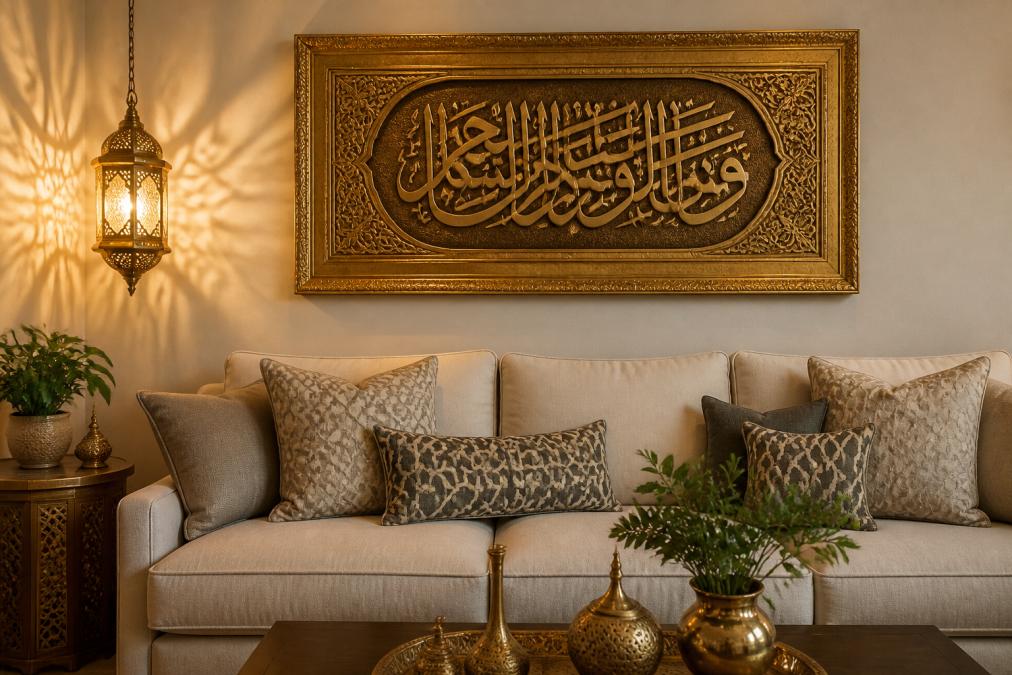
The living room is the most common location for Islamic wall art, typically above a sofa or fireplace where it functions as the room's visual centrepiece. Ayatul Kursi in a large format works well here because its scale matches main seating wall proportions. For prayer rooms, the art should face the direction of prayer where possible, and the space benefits from a curated, less decorative approach. A single piece of high-quality scripture art carries more weight than multiple competing pieces.
Hallways are underused spaces for Islamic calligraphy. A vertical piece with the Basmala or Names of Allah design creates a meaningful first impression without requiring significant floor space.
Minimalist Islamic Decor for Contemporary Interiors
Minimalist Islamic decor bridges traditional religious art and contemporary interior design, favouring clean lines, limited colour palettes, and scripts that read as graphic design. Kufic script in monochrome, geometric patterns derived from Islamic architecture, and single-word pieces like "Allah" in restrained typefaces all work within this aesthetic.
The key is consistency. A minimalist interior with a single bold piece of Islamic calligraphy in brushed steel reads as intentional and sophisticated. Multiple competing pieces in different styles reads as cluttered.
Bespoke Wall Art in the UK: What to Expect
Bespoke wall art in the UK covers custom-sized canvas prints to fully handcrafted metal pieces made to specific text, size, and finish. Knowing what questions to ask saves time and disappointment.
Custom Design Options and Sizing
Most suppliers offering bespoke Islamic wall art work from a brief specifying text, script style, dimensions, material, and finish. Standard lead times range from two to six weeks depending on complexity. Laser-cut metal pieces with intricate detail take longer than canvas prints.
The standard sizing advice is to choose a piece that fills roughly two-thirds of available wall width. For a 240 cm sofa wall, that means 150-160 cm total width. Narrower pieces look lost; wider pieces feel cramped.
Sustainability and Material Sourcing
Canvas prints vary in environmental impact depending on whether inks are water-based or solvent-based and whether wood frames are from certified suppliers. According to the Forestry Stewardship Council's certification standards, FSC-certified timber frames are the baseline to look for when sustainability matters.
Metal pieces made from recycled steel or aluminium have a strong sustainability case if manufacturing is energy-efficient. Asking suppliers about material sourcing is a reasonable and increasingly expected question.
Caring for Your Islamic Wall Art
Proper care extends the life of any wall art significantly. Islamic pieces in metal or canvas have specific requirements.
For canvas prints, dust with a dry microfibre cloth in gentle circular motions. Avoid damp cloths, which cause ink to bleed and frames to warp. Keep canvas pieces away from direct sunlight, which fades even archival inks. A position two to three metres from a window is generally safe.
For metal wall art, use a dry or very lightly dampened microfibre cloth. Avoid abrasive cleaners or anything containing bleach, which strips protective coatings. Gold-finished pieces are particularly susceptible to tarnishing.
3D stainless steel pieces with layered construction can trap dust between layers. A soft-bristled paintbrush is most effective for cleaning these areas. For pieces in kitchens or near cooking areas, monthly cleaning prevents grease accumulation.
Wall fixings matter significantly. Heavy metal pieces need wall plugs rated for their weight, fixed into masonry rather than just plaster. Use fixings rated to at least three times the piece's weight.
Recommended Islamic Wall Art from Wish Interiors
Wish Interiors stocks a curated range of wall art that complements Islamic home styling.

1. Talwara Square Filigree Gold Wall Art Metal, £44.99
The Talwara is the strongest choice for anyone seeking a metal wall art piece with Islamic geometric sensibility. At 65 cm x 65 cm, it anchors a hallway or bedside wall without overwhelming the space. The painted gold finish and filigree patterning create dynamic light play associated with traditional Islamic metalwork. This is the piece we recommend most often for first-time buyers of metal wall art.
2. Simbolo Metal Wall Sculpture by Orsina, £62.95
The Simbolo takes a more abstract approach, with layered metalwork patterns that read as contemporary art in neutral interiors. It suits living rooms and dining areas where buyers want a statement piece that does not announce its cultural reference explicitly. The light-responsive surface changes character throughout the day.
3. Design Toscano Celestial Harmony Sun and Moon Wall Sculpture, £81.74

For outdoor walls, garden rooms, or covered exterior spaces, the Celestial Harmony piece offers hand-cast quality in faux ivory and gold finish. The sun and moon motif has deep roots in Islamic astronomical tradition and works as a conversation-starting accent.
| Piece | Price | Material | Best For |
|---|---|---|---|
| Talwara Filigree Gold Wall Art | £44.99 | Metal, painted gold | Hallways, bedrooms, first-time buyers |
| Simbolo Metal Wall Sculpture | £62.95 | Metal, assorted finishes | Living rooms, contemporary interiors |
| Celestial Harmony Sculpture | £81.74 | Polyresin, faux ivory/gold | Outdoor walls, garden rooms |
Choosing the right Islamic wall art comes down to three decisions: the text or motif that carries personal meaning, the material that suits your room's light and style, and the scale that fits your wall. Wish Interiors offers a curated selection of wall art and home accessories, with the option to spread costs through Klarna. Browse the full range or call 020 46202525 to discuss your requirements with the team.
Frequently Asked Questions
Where can I buy high-quality Islamic wall art in the UK?
Wish Interiors stocks a curated range of Islamic wall art and complementary metal wall pieces, all available with fast UK delivery. The Talwara Square Filigree Gold Wall Art Metal (£44.99) is a strong starting point, combining intricate metalwork with a luxurious gold finish. For bespoke or custom Islamic wall art commissions, specialist makers can produce handcrafted pieces tailored to your exact dimensions and Quranic text preferences.
Is Islamic wall art considered halal for home decoration?
Generally, yes. Islamic scholars widely agree that scripture art featuring Quranic verses, the Names of Allah, or Arabic calligraphy is permissible and spiritually beneficial in the home. The key consideration is respectful placement: avoid hanging scripture art in bathrooms or anywhere it may be treated disrespectfully. Geometric Islamic patterns and abstract middle eastern decor carry no such restrictions and are universally accepted.
What are the most popular styles of Arabic calligraphy wall art?
Ayatul Kursi (Verse of the Throne) is consistently the most requested piece, followed by the Bismillah and Surah Al-Fatiha. In terms of script style, Thuluth and Naskh are the most widely used for their legibility and elegance. Kufic script, with its angular geometric quality, suits minimalist interiors particularly well. Triptych formats, three panels forming a single composition, are popular for larger living room walls.
How do I choose the right size Islamic wall art for my living room?
A piece hung above a sofa should span roughly two-thirds of the sofa's width. For a standard 200 cm sofa, aim for art between 120 cm and 140 cm wide. In a prayer room, a single centrepiece between 60 cm and 90 cm works well at eye level. For high-ceilinged rooms, a triptych or vertically stacked arrangement fills the wall without looking sparse. Always measure the wall space before ordering, particularly with bespoke or custom design pieces.
Can I find bespoke Islamic wall art to match my existing furniture?
Yes. Bespoke wall art commissions allow you to specify the Quranic verse, script style, dimensions, material (canvas, metal, or 3D stainless steel), and finish to coordinate with your existing scheme. Lead times for handcrafted custom pieces typically range from four to eight weeks depending on complexity. Wish Interiors can also advise on complementary metal wall art and decorative accessories to complete the look. Call 020 46202525 to discuss your requirements.
This article was written using GrandRanker
Sample Image Gallery


