





Durable Fabric Options for Commercial Upholstery Compared
Table of Contents
- What Makes Fabric Durable for Commercial Upholstery
- Understanding the Martindale Rub Test Explained
- Synthetic Fibres vs Natural Fibres for High-Traffic Areas
- Leather and Vinyl: Durability, Maintenance and Cost
- BS 5852 Fire Safety Standards for Upholstery
- Best Stain-Resistant Fabrics for Restaurants
- Comparison Table: Fabric Durability Ratings and Performance
- Cost-Per-Use Analysis: Long-Term Value of Durable Fabrics
- Frequently Asked Questions
Last Updated: September 2, 2026
What Makes Fabric Durable for Commercial Upholstery
Durability in commercial upholstery depends on the intersection of fibre strength, weave construction, and resistance to specific stresses. When specifying fabrics for high-traffic environments, you're betting on how well the material withstands daily wear, cleaning protocols, and unpredictable damage in shared spaces.
The difference between a fabric lasting five years versus fifteen often comes down to mill-level decisions: fibre selection, yarn twist, weave density, and finishing treatments. A restaurant booth needs different properties than a hotel lobby chair, one prioritises stain resistance while the other balances durability with acoustic absorption.
At Wish Interiors, we've specified fabrics for commercial projects ranging from boutique hotels to corporate offices. The most durable fabrics share three characteristics: they use synthetic fibres or blends engineered to resist abrasion; they're constructed with high weave density, typically 400 GSM or higher; and they've been treated with protective finishes that repel moisture and resist staining without compromising breathability.
Understanding the Martindale Rub Test Explained
The Martindale rub test measures abrasion resistance by rubbing a standardised fabric sample against itself repeatedly until visible wear appears. The result, expressed as "double rubs", indicates how many cycles a fabric can withstand before pilling, fuzzing, or showing noticeable wear.
A Martindale count of 15,000 double rubs is acceptable for light residential use. For commercial applications, 30,000 double rubs is standard for moderate-traffic spaces, while 50,000+ is required for high-traffic areas like hotel lobbies, airports, and restaurants. Premium commercial fabrics exceed 100,000 double rubs.
In practice, a 50,000 rating doesn't guarantee identical performance across different environments. The Martindale test measures abrasion under controlled laboratory conditions. Real-world wear is messier, a restaurant booth faces friction from clothing, moisture, food spills, and aggressive cleaning, while an office chair faces concentrated pressure points and directional wear. Treat the Martindale count as a minimum threshold rather than a longevity prediction.
Synthetic Fibres vs Natural Fibres for High-Traffic Areas
Synthetic fibres, polyester, olefin, and acrylic, dominate commercial upholstery because they resist moisture, staining, and abrasion. Natural fibres, wool, cotton, and linen, offer superior aesthetics and breathability but require careful specification for commercial use.
The choice comes down to priorities. If stain resistance and easy cleaning are non-negotiable, synthetics win. If you'll accept higher maintenance for luxury feel and acoustic properties, natural fibres or high-quality blends become viable.
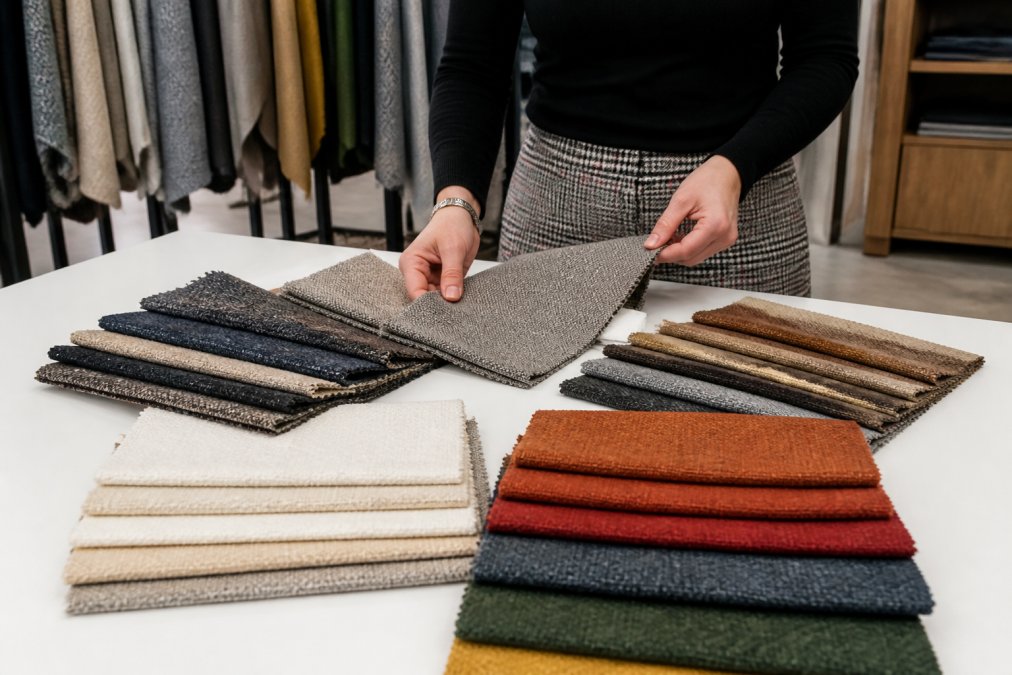
Polyester, Olefin and Acrylic for Commercial Spaces
Polyester is the workhorse of commercial upholstery. It's hydrophobic, naturally repelling water and resisting staining. A polyester fabric rated at 50,000 Martindale double rubs with a hydrophobic finish handles spilled coffee, wine, and grease, you blot it away before it sets. Polyester is also colourfast, with dyes holding well under UV exposure and repeated cleaning.
Olefin (polypropylene) is even more water-resistant because the fibre itself is hydrophobic at a molecular level. It's commonly used in high-moisture commercial environments like swimming pool lounges or hospital waiting areas. The trade-off: olefin has a lower melting point than polyester, making it less suitable where heat exposure is a concern.
Acrylic fibres are softer than polyester and olefin, offering a wool-like hand feel while retaining synthetic durability. Acrylic fabrics achieve 50,000+ Martindale ratings while maintaining a premium aesthetic, making them ideal for hospitality settings.
Most commercial-grade fabrics are blends rather than single fibres. A polyester-acrylic blend gives you acrylic's soft feel and dyeability with polyester's stain resistance and durability.
Wool and Cotton in Commercial Settings
Wool is naturally resilient and flame-resistant, ideal for commercial environments with strict fire safety requirements. A pure wool fabric can achieve 40,000+ Martindale ratings, particularly when tightly twisted and densely woven (peer-reviewed research). Wool also provides superior acoustic absorption, important in open-plan offices.
The catch: wool absorbs moisture readily, making it vulnerable to staining unless treated with protective finishes. A wool fabric in a restaurant requires aggressive stain-resistance treatment, which can change the hand feel and increase cost. Wool also pills more readily than synthetics when exposed to abrasion, though high-quality commercial wool is specially processed to minimise this.
Cotton is breathable but performs poorly in high-traffic commercial applications. Cotton absorbs moisture, stains readily, and has lower abrasion resistance than synthetics or wool, achieving only 20,000 Martindale ratings at best, inadequate for most commercial environments.
Wool-synthetic blends offer a practical middle ground. A 70% wool, 30% polyester blend provides wool's acoustic properties and natural resilience with polyester's stain resistance, typically achieving 40,000-60,000 Martindale ratings.
Leather and Vinyl: Durability, Maintenance and Cost
Leather offers unmatched durability and luxury appearance. Real leather is essentially indestructible under normal use and doesn't pill, fray, or show wear like fabrics do. Instead, it develops a patina, with scratches becoming part of its character.

The challenge is maintenance. Leather requires regular conditioning to prevent drying and cracking. Spills must be cleaned promptly. In high-traffic environments like restaurants, leather seating requires professional cleaning every 6-12 months, a significant operational cost.
Vinyl (polyurethane or PVC) mimics leather's appearance and ease of cleaning while reducing cost and maintenance. Vinyl is completely waterproof and cleans easily with a damp cloth, requiring no conditioning. Commercial-grade vinyl achieves equivalent durability to real leather at 30-40% of the cost.
The trade-off: vinyl doesn't age as gracefully as leather. After 5-7 years, vinyl begins to crack and peel, particularly in areas of heavy use and temperature fluctuation. Real leather, properly maintained, lasts 15-20 years or longer.
For Wish Interiors's commercial clients, leather is specified for boutique hotels and upscale restaurants where the investment aligns with brand aesthetic and budget. Vinyl is chosen for high-turnover hospitality environments where ease of cleaning and cost control are priorities.
| Material | Martindale Rating | Maintenance | Lifespan | Cost | Best For |
|---|---|---|---|---|---|
| Polyester blend | 50,000+ | Regular cleaning | 8-12 years | £ | Restaurants, offices |
| Wool blend | 40,000-60,000 | Spot cleaning | 10-15 years | £££ | Hotels, corporate |
| Acrylic | 50,000+ | Regular cleaning | 8-12 years | £££ | Hospitality, design-led |
| Real leather | N/A | Conditioning, professional cleaning | 15-20 years | £££££ | Luxury hotels, boardrooms |
| Vinyl | N/A | Wipe-clean | 5-7 years | ££ | High-traffic, moisture-prone |
BS 5852 Fire Safety Standards for Upholstery
BS 5852 is the UK standard for fire safety of upholstered furniture (BSI Group standards development). Any upholstery fabric specified for commercial use in the UK must meet minimum requirements under this standard, or you expose the business owner to liability and potential enforcement action.
BS 5852 defines several test classifications, with Crib 5 being the most stringent for commercial applications. A fabric passing Crib 5 has been tested against a specific ignition source and must not ignite or propagate flame beyond defined limits. Most commercial-grade upholstery fabrics meet Crib 5 or higher, but you must verify this in the technical specification sheet.
Fire-retardant treatments are applied to fabrics that wouldn't otherwise meet BS 5852 requirements. These chemical finishes slow flame spread and reduce smoke emission. However, they can affect the fabric's hand feel, colour, and durability.
For commercial projects, always request the BS 5852 classification in writing from the fabric supplier and include it in your specification document. If a supplier can't provide this information, that's a red flag.
Best Stain-Resistant Fabrics for Restaurants
Restaurants demand fabrics that resist both water-based and oil-based stains. The best restaurant upholstery fabrics combine hydrophobic fibre (polyester or olefin) with a topical stain-resistant finish like Scotchgard or Teflon.
Polyester fabrics with a hydrophobic finish are the industry standard for restaurant booths. A 100% polyester fabric rated at 50,000+ Martindale with a hydrophobic finish handles daily spills without staining. The tight weave prevents liquids from penetrating the yarn structure, and the topical finish repels both water and oil-based contaminants.
Olefin blends are even more stain-resistant because the fibre itself is hydrophobic. A 70% olefin, 30% polyester blend is virtually immune to water-based stains and highly resistant to oil-based stains. However, olefin has lower abrasion resistance than polyester, making it less suitable for high-wear seat cushions.
The most practical approach for restaurants is a layered strategy: use polyester-dominant fabric for seat cushions (high wear) and olefin-dominant fabric for back panels (lower wear, higher stain exposure). This balances durability with stain resistance.
Comparison Table: Fabric Durability Ratings and Performance
| Fabric Type | Martindale Rating | Stain Resistance | Fire Safety (BS 5852) | Maintenance | Cost per Metre | Commercial Grade |
|---|---|---|---|---|---|---|
| Polyester blend (standard) | 50,000 | Excellent | Pass (with treatment) | Regular cleaning | £25-45 | Yes |
| Polyester blend (premium) | 75,000+ | Excellent | Pass (inherent) | Regular cleaning | £45-75 | Yes |
| Olefin blend | 40,000-50,000 | Excellent | Pass (with treatment) | Regular cleaning | £20-40 | Yes |
| Acrylic (commercial) | 50,000+ | Good | Pass (with treatment) | Regular cleaning | £35-65 | Yes |
| Wool blend (70/30) | 40,000-60,000 | Good | Pass (inherent) | Spot cleaning | £50-90 | Yes |
| Pure wool | 40,000 | Fair | Pass (inherent) | Spot cleaning | £60-120 | Limited |
| Cotton (any weight) | 15,000-25,000 | Poor | Pass (with treatment) | Frequent cleaning | £15-35 | No |
| Real leather | N/A | Good | Pass (inherent) | Conditioning | £150-400+ | Yes |
| Vinyl | N/A | Excellent | Pass (inherent) | Wipe-clean | £40-80 | Yes |
Cost-Per-Use Analysis: Long-Term Value of Durable Fabrics
A budget fabric costs less upfront but often costs more over the furniture's lifetime. A restaurant booth upholstered in a 20,000 Martindale cotton-blend fabric costs £800 initially. After three years of daily use, it's visibly worn and stained. Re-upholstering costs another £800. Over ten years, you've spent £2,400 on upholstery.
The same booth upholstered in a 50,000 Martindale polyester blend costs £1,200 initially. With proper maintenance, it lasts 8-10 years. Over ten years, you've spent £1,200 on upholstery.
Cost-per-use includes labour costs for re-upholstering, downtime when furniture is out of service, and maintenance costs. A leather booth requires professional cleaning every 6-12 months at £150-300 per cleaning. A polyester booth requires regular vacuuming and spot cleaning, mostly in-house labour.
For a 40-room boutique hotel, the difference is significant. Leather seating in each room costs £3,000 per room upfront (£120,000 total) plus £6,000-12,000 annually in professional cleaning. A polyester alternative costs £1,800 per room (£72,000 total) with minimal maintenance. Over five years, polyester costs £77,000 total. Leather costs £150,000-180,000 total.
The calculation changes if leather is part of the brand experience. For a mid-range hotel where guests expect comfort and cleanliness but not luxury materials, polyester makes financial sense.
Wish Interiors works with commercial clients to model these scenarios. A boutique hotel might specify leather for the lobby and suites while choosing durable polyester for the restaurant and bar. A corporate office might specify wool-blend fabric for executive spaces and polyester for open-plan areas where wear is heavier.
Make the cost-per-use calculation explicit: upfront cost, expected lifespan, annual maintenance cost, and replacement cost. Compare options across the full lifecycle, not just the purchase price.
When specifying fabrics for commercial upholstery, you're making a decision affecting your space for years. Technical specifications, Martindale rating, GSM weight, fibre composition, and BS 5852 classification, matter because they predict real-world performance. At Wish Interiors, we've spent over 60 years working with commercial clients to match fabrics to their specific environments. Our bespoke approach means we recommend the exact weight, weave, and finish that delivers durability without compromise. Whether you're furnishing a boutique hotel, restaurant, or corporate office, we can help you specify fabrics that balance aesthetics, durability, and cost. For a consultation on your commercial project, call 020 46202525.
Frequently Asked Questions
What is the most durable upholstery fabric for commercial use?
Polyester and olefin rank among the most durable fabrics for commercial upholstery, typically achieving 100,000+ Martindale rub counts. Leather offers exceptional durability with proper maintenance, though it costs more. For hospitality and high-traffic restaurants, solution-dyed polyester provides superior stain resistance and colour retention. The best choice depends on your space's traffic volume, budget, and aesthetic requirements. Wish Interiors can advise on custom upholstery solutions tailored to your commercial needs.
How do Martindale rub test scores determine fabric durability?
The Martindale rub test measures how many double rubs a fabric can withstand before visible wear appears. Commercial-grade fabrics typically require 15,000+ double rubs; hospitality applications demand 30,000+. Higher scores indicate greater resistance to pilling, abrasion, and surface degradation. A fabric rated at 100,000 double rubs will outlast one rated at 20,000 in busy environments. This standardised test helps designers specify fabrics confidently for restaurants, hotels, and office spaces where durability directly affects long-term value.
Which fire retardancy standards must commercial upholstery meet?
In the UK, commercial upholstery must comply with BS 5852, which sets flammability requirements for upholstered furniture. Different sections apply depending on the fabric and foam combination; hospitality furniture typically requires higher ignition resistance. The standard ensures fabrics resist ignition from cigarettes and matches, protecting occupants and meeting building regulations. When specifying durable fabrics for restaurants, hotels, or offices, always confirm BS 5852 compliance. Wish Interiors ensures all bespoke commercial pieces meet these safety standards as part of our craftsmanship commitment.
What's the difference between solution-dyed and piece-dyed fabrics for stain resistance?
Solution-dyed fabrics have colour built into the fibre itself before weaving, making them inherently stain-resistant and fade-resistant. Piece-dyed fabrics are dyed after weaving, leaving the surface more vulnerable to staining and colour loss. For restaurants and high-traffic commercial spaces, solution-dyed polyester and olefin fabrics resist spills better and maintain colour longer under UV exposure. They're easier to clean and typically cost less than natural fibres whilst offering superior durability. This makes them ideal for venues where appearance and maintenance matter equally.
This article was written using GrandRanker
Sample Image Gallery


